Showing posts with label simulation. Show all posts

Friday, March 19, 2021

Back to Robot Coding part 3: testing the EBB

In part 2 a few weeks ago I outlined a Python implementation of the ethical black box. I described the key data structure - a dictionary which serves as both specification for the type of robot, and the data structure used to deliver live data to the EBB. I also mentioned the other key robot specific code: 

# Get data from the robot and store it in data structure spec
def getRobotData(spec):

Having reached this point I needed a robot - and a way of communicating with it - so that I could both write getRobotData(spec) and test the EBB. But how to do this? I'm working from home during lockdown, and my e-puck robots are all in the lab. Then I remembered that the excellent robot simulator V-REP (now called CoppeliaSim) has a pretty good e-puck model and some nice demo scenes. V-REP also offers multiple ways of communicating between simulated robots and external programs (see here). One of them - TCP/IP sockets - appeals to me as I've written sockets code many times, for both real-world and research applications.  Then a stroke of luck: I found that a team at Ensta-Bretagne had written a simple demo which shows how to connect a Python program to a robot in V-REP, using sockets. So, first I got that demo running and figured out how it works, then used the same approach for a simulated e-puck and the EBB. Here is a video capture of the working demo.


So, what's going on in the demo? The visible simulation views in the V-REP window show an e-puck robot following a black line which is blocked by both a potted plant and an obstacle constructed from 3 cylinders. The robot has two behaviours: line following and wall following. The EBB requests data from the e-puck robot once per second, and you can see those data in the Python shell window. Reading from left to right you will see first the EBB date and time stamp, then robot time botT, then the 3 line following sensors lfSe, followed by the 8 infra red proximity sensors irSe. The final two fields show the joint (i.e. wheel) angles jntA, in degrees, then the motor commands jntD. By watching these values as the robot follows its line and negotiates the two obstacles you can see how the line and infra red sensor values change, resulting in updated motor commands.

Here is the code - which is custom written both for this robot and the means of communicating with it - for requesting data from the robot.

# Get data from the robot and store it in spec[]
# while returning one of the following result codes
ROBOT_DATA_OK = 0
CANNOT_CONNECT = 1
SOCKET_ERROR = 2
BAD_DATA = 3

def getRobotData(spec):

    # This function connects, via TCP/IP to an ePuck robot in V-REP

    # create a TCP/IP socket and connect it to the simulated robot
    sock = socket.socket(socket.AF_INET, socket.SOCK_STREAM)
    try:
        sock.connect(server_address_port)
    except:
        return CANNOT_CONNECT

    sock.settimeout(0.1) # set connection timeout
    
    # pack a dummy packet that will provoke data in response
    #   this is, in effect, a 'ping' to ask for a data record
    strSend = struct.pack('fff',1.0,1.0,1.0)
    sock.sendall(strSend) # and send it to V-REP

    # wait for data back from V-REP
    #   expect a packet with 1 time, 2 joints, 2 motors,   
    #   3 line sensors and 8 irSensors. All floats because V-REP
    #   total packet size = 16 x 4 = 64 bytes
    data = b''
    nch_rx = 64 # expect this many bytes from  V-REP 
    try:
        while len(data) < nch_rx:
            data += sock.recv(nch_rx)
    except:
        sock.close()
        return SOCKET_ERROR

    # unpack the received data
    if len(data) == nch_rx:
        # V-REP packs and unpacks in floats only so...
        vrx = struct.unpack('ffffffffffffffff',data)

        # now move data from vrx[] into spec[], while rounding floats
        spec["botTime"] = [ round(vrx[0],2) ] 
        spec["jntDemands"] = [ round(vrx[1],2), round(vrx[2],2) ]
        spec["jntAngles"] = [ round(vrx[3]*180.0/math.pi,2)
                              round(vrx[4]*180.0/math.pi,2) ]
        spec["lfSensors"] = [ round(vrx[5],2), 
                              round(vrx[6],2), round(vrx[7],2) ]
        for i in range(8):
            spec["irSensors"][i] = round(vrx[8+i],3)       
        result = ROBOT_DATA_OK
    else:       
        result = BAD_DATA

    sock.close()
    return result

The structure of this function is very simple: first create a socket then open it, then make a dummy packet and send it to V-REP to request EBB data from the robot. Then, when a data packet arrives, unpack it into spec, then close the socket before returning. The most complex part of the code is data wrangling.

Would a real EBB collect data in this way? Well if the EBB is embedded in the robot then probably not. Communication between the robot controller and the EBB might be via ROS messages, or even more directly, by - for instance - allowing the EBB code to access a shared memory space which contains the robot's sensor inputs, command outputs and decisions. But an external EBB, either running on a local server or in the cloud, would most likely use TCP/IP to communicate with the robot, so getRobotData() would look very much like the example here. 

Thursday, August 20, 2020

"Why Did You Just Do That?" Explainability and Artificial Theory of Mind for Social Robots

This week I have been attending (virtually) the excellent RoboPhilosophy conference, and this morning gave a plenary talk "Why did you just do that?" Here is the abstract:
An important aspect of transparency is enabling a user to understand what a robot might do in different circumstances. An elderly person might be very unsure about robots, so it is important that her assisted living robot is helpful, predictable – never does anything that puzzles or frightens her – and above all safe. It should be easy for her to learn what the robot does and why, in different circumstances, so that she can build a mental model of her robot. An intuitive approach would be for the robot to be able to explain itself, in natural language, in response to spoken requests such as “Robot, why did you just do that?” or “Robot, what would you do if I fell down?” In this talk I will outline current work, within project RoboTIPS, to apply recent research on artificial theory of mind to the challenge of providing social robots with the ability to explain themselves. 
And here are the slides:


Here are links to the movies:


And here are the papers referenced in the talk, with links:
  1. Jobin, A., Ienca, M. & Vayena, E. (2019) The global landscape of AI ethics guidelines. Nat Mach Intell 1, 389–399
  2. Winfield, A. Ethical standards in robotics and AI. Nature Electronics 2, 46–48 (2019).  Pre-print here.
  3. Winfield, A. F. (2018) Experiments in Artificial Theory of Mind: from safety to story telling. Front. Robot. AI 5:75.
  4. Blum, C., Winfield, A. F. and Hafner, V. V. (2018) Simulation-based internal models for safer robots. Frontiers in Robotics and AI, 4 (74). pp. 1-17.
  5. Vanderelst, D. and Winfield, A. F. (2018) An architecture for ethical robots inspired by the simulation theory of cognition. Cognitive Systems Research, 48. pp. 56-66.
  6. Winfield AFT (2018) When Robots Tell Each Other Stories: The Emergence of Artificial Fiction. In: Walsh R., Stepney S. (eds) Narrating Complexity. Springer, Cham. Preprint here.
  7. Winfield, AF and Jirotka, M. (2017) The case for an ethical black box. In: Gao, Y. et al, eds. (2017) Towards Autonomous Robot Systems. LNCS 10454, pp. 262-273, Springer. Preprint here.
  8. Winfield AFT, Katie Winkle, Helena Webb, Ulrik Lyngs, Marina Jirotka and Carl Macrae, Robot Accident Investigation: a case study in Responsible Robotics, chapter submitted to RoboSoft.
and mentioned in the Q&A:
  1. Winfield, AF, K. Michael, J. Pitt and V. Evers (2019) Machine Ethics: The Design and Governance of Ethical AI and Autonomous Systems [Scanning the Issue], in Proceedings of the IEEE, vol. 107, no. 3, pp. 509-517.
  2. Vanderelst, D. and Winfield, A. (2018), The Dark Side of Ethical Robots, AIES '18: Proceedings of the 2018 AAAI/ACM Conference on AI, Ethics, and Society Dec 2018 Pages 317–322. 

Wednesday, July 31, 2019

On the simulation (and energy costs) of human intelligence, the singularity and simulationism

For many researchers the Holy Grail of robotics and AI is the creation of artificial persons: artefacts with equivalent general competencies as humans. Such artefacts would literally be simulations of humans. Some researchers are motivated by the utility of AGI; others have an almost religious faith in the transhumanist promise of the technological singularity. Others, like myself, are driven only by scientific curiosity. Simulations of intelligence provide us with working models of (elements of) natural intelligence. As Richard Feynman famously said ‘What I cannot create, I do not understand’. Used in this way simulations are like microscopes for the study of intelligence; they are scientific instruments.

Like all scientific instruments simulation needs to be used with great care; simulations need to be calibrated, validated and – most importantly – their limitations understood. Without that understanding any claims to new insights into the nature of intelligence – or for the quality and fidelity of an artificial intelligence as a model of some aspect of natural intelligence – should be regarded with suspicion.

In this essay I have critically reflected on some of the predictions for human-equivalent AI (AGI); the paths to AGI (and especially via artificial evolution); the technological singularity, and the idea that we are ourselves simulations in a simulated universe (simulationism). The quest for human-equivalent AI clearly faces many challenges. One (perhaps stating the obvious) is that it is a very hard problem. Another, as I have argued in this essay, is that the energy costs are likely to limit progress.

However, I believe that the task is made even more difficult for two further reasons. The first is – as hinted above – that we have failed to recognize simulations of intelligence (which all AIs and robots are) as scientific instruments, which need to be designed, operated and results interpreted, with no less care than we would a particle collider or the Hubble telescope.

The second, and more general observation, is that we lack a general (mathematical) theory of intelligence. This lack of theory means that a significant proportion of AI research is not hypothesis  driven, but incrementalist and ad-hoc. Of course such an approach can and is leading to interesting  and (commercially) valuable advances in narrow AI. But without strong theoretical foundations, the grand challenge of human-equivalent AI seems rather like trying to build particle accelerators to understand the nature of matter, without the Standard Model of particle physics.

The text above is the concluding discussion of my essay On the simulation (and energy costs) of human intelligence, the singularity and simulationism, which appears in an edited collection of essays in a book called From Astrophysics to Unconventional Computation. Published in April 2019, the book marks the 60th birthday of astrophysicist, computer scientist and all round genius, Susan Stepney.

Note: regular visitors to the blog will recognise themes covered in several previous blog posts, brought together in I hope a coherent and interesting way.

Sunday, January 27, 2019

When Robots Tell Each Other Stories: The Emergence of Artificial Fiction

When I wrote about story-telling robots nearly 7 years ago I had no idea how we could actually build robots that can tell each other stories. Now I believe I do, and my paper setting out how has just been published in a new volume called Narrating Complexity. You can find a pdf online here.

The book emerged from a hugely interesting series of workshops, led by Richard Walsh and Susan Stepney, which brought together several humanities disciplines including narratology, with complexity scientists, systems biologists and a roboticist (me). It was at one of those workshops that I realised that simulation-based internal models - the focus of much of my recent work - could form the basis for story-telling.

To recap: a simulation-based internal model is a computer simulation of a robot and its environment, including other robots, inside itself. Like animals all robots have a set of next possible actions, but unlike animals (and especially humans) robots have only a small repertoire of actions. With an internal model a robot can predict what might happen (in its immediate future) for each of those next possible actions. I call this model a consequence engine because it gives the robot a powerful way of predicting the consequences of its actions, for both itself and other robots.

So, how can we use the consequence engine to make story-telling robots?

When the robot runs its consequence engine it is asking itself a 'what if' question; 'what if I turned left?' or, 'what if I just stand here?'. Some researchers have called a simulation-based internal model a 'functional imagination' and it's not a bad metaphor. Our robot 'imagines' what might happen in different circumstances. And when the robot has imagined something it has a kind of internal narrative: 'if I turn left I will likely crash into the wall'. In a way the robot is telling itself a story about something that might happen. In Dennett's conceptual Tower-of-Generate-and-Test the robot is a Popperian creature.

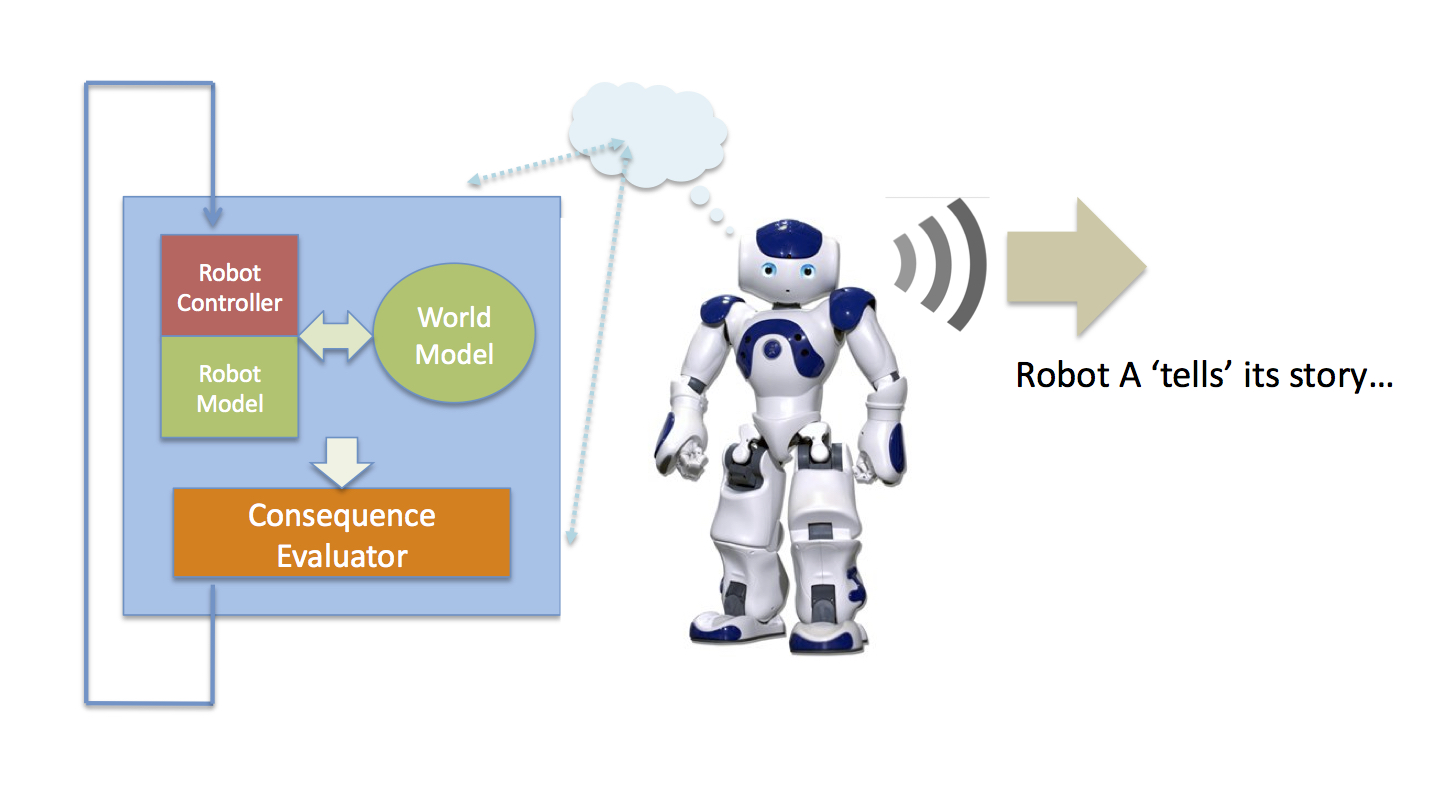
Now consider the possibility that the robot converts that internal narrative into speech, and literally speaks it out loud. With current speech synthesis technology that should be relatively easy to do. Here is a diagram showing this.

The blue box on the left is a simplified version of the consequence engine; it's the cognitive machinery that allows the robot to predict the consequences of a particular action. For an outline of how it works there's a description in the paper.

Another robot (B) is equipped with exactly the same cognitive machinery as robot A, and - as shown below robot B listens to robot A's 'story' (using speech recognition), interprets that story as an action and a consequence, which it 'runs' in its consequence engine. In effect robot B 'imagines' robot A's story. It 'imagines' turning left and crashing into the wall - even though it might not be standing near a wall to its left.

The new idea here is that the listener robot (B) converts the story it has heard into a 'what if' question, then 'runs' it in its own consequence engine. In a sense A has invited B to imagine itself in A's shoes. Although compared with the stories we humans tell each other, A's story is trivial, it does I suggest have all the key elements. And of course A and B are not limited to fictional stories: A could - just as easily - recount something that has actually happened to it, like 'I turned right to avoid crashing into the wall'.

You may be wondering 'ok but where is the meaning? Surely B cannot really understand A's simple stories..?' Here I am going to stick my neck out and suggest that the process of re-imagining is what understanding is. Of course you and I can imagine a vast range of things, including situations that no human has ever (or perhaps could ever) experience; Roy Batty's famous line "I've seen things you people wouldn't believe. Attack ships on fire off the shoulder of Orion..." comes to mind.

In contrast our robots have a profoundly limited imagination; their world (both real and imagined) contains only the objects and hazards of their immediate environment and they are capable only of imagining next possible actions and the immediate consequences of those actions. And that limited imagination does have the simple physics of collisions built in (providing the robot with a kind of common sense). But I contend that - within the constraints of that very limited imagination - our robots can properly be said to 'understand' each other.

But perhaps I'm getting ahead of myself, given that we haven't actually run the experiments yet.


Friday, September 28, 2018

Experiments in Artificial Theory of Mind

Since setting out my initial thoughts on robots with simulation-based internal models about 5 years ago - initially in the context of ethical robots - I've had a larger ambition for these models: that they might provide us with a way of building robots with artificial theory of mind - something I first suggested when I outlined the consequence engine 4 years ago.

Since then we've been busy experimentally applying our consequence engine in the lab, in a range of contexts including ethics, safety and imitation, giving me little time to think about theory of mind. But then, in January 2017 I was contacted by Antonio Chella, inviting me to submit a paper to a special issue on Consciousness in Humanoid Robots. After some hesitation on my part and encouragement on Antonio's I realised that this was a perfect opportunity.

Of course theory of mind is not consciousness but it is for sure deeply implicated. And, as I discovered while researching the paper, the role of theory of mind in consciousness (or, indeed of consciousness in theory of mind) is both unclear and controversial. So, this paper, written in the autumn of 2017, submitted January 2018, and - after tough review and major revisions - accepted in June 2018, is my first (somewhat tentative) contribution to the machine consciousness literature.

Experiments in Artificial Theory of Mind: From Safety to Story-Telling, advances the hypothesis that simulation-based internal models offer a powerful and realisable, theory-driven basis for artificial theory of mind.

Here is the abstract
Theory of mind is the term given by philosophers and psychologists for the ability to form a predictive model of self and others. In this paper we focus on synthetic models of theory of mind. We contend firstly that such models—especially when tested experimentally—can provide useful insights into cognition, and secondly that artificial theory of mind can provide intelligent robots with powerful new capabilities, in particular social intelligence for human-robot interaction. This paper advances the hypothesis that simulation-based internal models offer a powerful and realisable, theory-driven basis for artificial theory of mind. Proposed as a computational model of the simulation theory of mind, our simulation-based internal model equips a robot with an internal model of itself and its environment, including other dynamic actors, which can test (i.e., simulate) the robot’s next possible actions and hence anticipate the likely consequences of those actions both for itself and others. Although it falls far short of a full artificial theory of mind, our model does allow us to test several interesting scenarios: in some of these a robot equipped with the internal model interacts with other robots without an internal model, but acting as proxy humans; in others two robots each with a simulation-based internal model interact with each other. We outline a series of experiments which each demonstrate some aspect of artificial theory of mind.
For an outline of the work of the paper see the slides below, presented first at the SPANNER workshop in York in September 2018, then at a workshop on Social Learning and Cultural Evolution at ALife 2019 in July 2019.


In fact all of the experiments outlined here have been described in some detail in previous blog posts (although not in the context of artificial theory of mind):
  1. The Corridor experiment 
  2. The Pedestrian experiment
  3. The Ethical robot experiments: with e-puck robots and with NAO robots
  4. Experiments on rational imitation (the imitation of goals)
  5. Story-telling robots**
The thing that ties all of these experiments together is that they all make use of a simulation-based internal model (which we call a consequence engine), which allows our robot to model and hence predict the likely consequences of each of its next possible actions, both for itself and for the other dynamic actors it is interacting with. In some of the experiments those actors are robots acting as proxy humans, so those experiments (in particular the corridor and ethical robot experiments) are really concerned with human-robot interaction.

Theory of mind is the ability to form a predictive model of ourselves and others; it's the thing that allows us to infer the beliefs and intentions of others. Curiously there are two main theories of mind: the 'theory theory' and the 'simulation theory'. The theory theory (TT) holds that one intelligent agent’s understanding of another’s mind is based on innate or learned rules, sometimes known as folk psychology. In TT these hidden rules constitute a 'theory' because they can be used to both explain and make predictions about others’ intentions.  The simulation theory (ST) instead holds that “we use our own mental apparatus to form predictions and explanations of someone by putting ourselves in the shoes of another person and simulating them” (Michlmayr, 2002).

When we hold our simulation-based internal model up against the simulation theory of mind, the two appear to mirror each other remarkably well. If a robot has a simulation of itself inside itself then it can explain and predict the actions of both itself, and others like itself by using its simulation-based internal model to model them. Thus we have an embodied computational model of theory of mind, in short artificial theory of mind.

So, what properties of theory of mind (ToM) are demonstrated in our five experiments?

Well, the first thing to note is that not all experiments implement full ST. In the corridor, pedestrian and ethical robot experiments robots predict their own actions using the simulation-based internal model, i.e. ST, but use a much simpler TT to model the other robots; we use a simple ballistic model for those other robots (i.e. by assuming the robot will continue to move at the speed and direction it is currently moving). Thus I describe these experiments as ST (self) + TT (other), or just ST+TT for short. I argue that this hybrid form of artificial ToM is perfectly valid, since you and I clearly don't model strangers we are trying to avoid in a crowded corridor as anything other than people moving in a particular direction and speed. We don't need to try and intuit their state of mind, only where they are going.

The rational imitation and story-telling experiments do however, use ST for both self and other, since a simple TT will not allow an imitating robot to infer the goals of the demonstrating robot, nor is it sufficient to allow a listener robot to 'imagine' the story told by the storytelling robot.

The table below summarises these differences and highlights the different aspects of theory of mind demonstrated in each of the five experiments.

*Theory Mode: ST (self) + TT/ST (other)

An unexpected real-world use for the approach set out in this paper, is to allow robots to explain themselves. I believe explainability will be especially important for social robots, i.e. robots designed to interact with people. Let me explain by quoting two paragraphs from the paper.

A major problem with human-robot interaction is the serious asymmetry of theory of mind. Consider an elderly person and her care robot. It is likely that a reasonably sophisticated near-future care robot will have a built-in (TT) model of an elderly human (or even of a particular human). This places the robot at an advantage because the elderly person has no theory of mind at all for the robot, whereas the robot has a (likely limited) theory of mind for her. Actually the situation may be worse than this, since our elderly person may have a completely incorrect theory of mind for the robot, perhaps based on preconceptions or misunderstandings of how the robot should behave and why. Thus, when the robot actually behaves in a way that doesn’t make sense to the elderly person, her trust in the robot will be damaged and its effectiveness diminished.

The storytelling model proposed here provides us with a powerful mechanism for the robot to be able to generate explanations for its actual or possible actions. Especially important is that the robot’s user should be able to ask (or press a button to ask) the robot to explain “why did you just do that?” Or, pre-emptively, to ask the robot questions such as “what would you do if I fell down?” Assuming that the care robot is equipped with an autobiographical memory, the first of these questions would require it to re-run and narrate the most recent action sequence to be able to explain why it acted as it did, i.e., “I turned left because I didn’t want to bump into you.” The second kind of pre-emptive query requires the robot to interpret the question in such a way it can first initialize its internal model to match the situation described, run that model, then narrate the actions it predicts it would take in that situation. In this case the robot acts first as a listener, then as the narrator (see slide 18 above). In this way the robot would actively assist its human user to build a theory-of-mind for the robot.


**This one remains, for the time-being, a thought experiment.

See also: When Robots Tell Each Other Stories: The Emergence of Artificial Fiction

Reference:

Michlmayr, M. (2002). Simulation Theory Versus Theory Theory: Theories Concerning the Ability to Read Minds. Master’s thesis, Leopold-Franzens- Universität Innsbruck.

Thursday, August 30, 2018

The Pedestrian Experiment

Followers of this blog will know that I have been working for some years on simulation-based internal models - demonstrating their potential for ethical robotssafer robots and imitating robots. But pretty much all of our experiments so far have involved only one robot with a simulation-based internal model while the other robots it interacts with have no internal model at all.

But some time ago we wondered what would happen if two robots, each with a simulation-based internal model, interacted with each other. Imagine two such robots approaching each other in the same way that two pedestrians approach each other on the sidewalk. Is it possible that these 'pedestrian' robots might, from time to time, engage in the kind of 'dance' that human pedestrians do when one steps to their left and the other to their right only to compound the problem of avoiding a collision with a stranger? The answer, it turns out, is yes!

The idea was taken up by Mathias Schmerling at the Humboldt University of Berlin, adapting the code developed by Christian Blum for the Corridor experiment. Chen Yang, one of my masters students, has now updated Mathias' code and has produced some very nice new results.

Most of the time the pedestrian robots pass each other without fuss but in something between 1 in 5 and 1 in 10 trials we do indeed see an interesting dance. Here are a couple of examples of the majority of trials, when the robots pass each other normally, showing the robots' trajectories. In each trial blue starts from the left and green from the right. Note that there is an element of randomness in the initial directions of each robot (which almost certainly explains the relative occurrence of normal and dance behaviours).


And here is a gif animation showing what's going on in a normal trial. The faint straight lines from each robot show the target directions for each next possible action modelled in each robot's simulation-based internal model (consequence engine); the various dotted lines show the predicted paths (and possible collisions) and the solid blue and green lines show which next action is actually selected following the internal modelling.


Here is a beautiful example of a 'dance', again showing the robot trajectories. Note that the impasse resolves itself after awhile. We're still trying to figure out exactly what mechanism enables this resolution.


And here is the gif animation of the same trial:


Notice that the impasse is not resolved until the fifth turns of each robot.

Is this the first time that pedestrians passing each other - and in particular the occasional dance that ensues - has been computationally modelled?

All of the results above were obtained in simulation (yes there really are simulations within a simulation going on here), but within the past week Chen Yang has got this experiment working with real e-puck robots. Videos will follow shortly.


Acknowledgements.

I am indebted to the brilliant experimental work of first Christian Blum (supported by Wenguo Liu), then Mathias Schmerling who adapted Christian's code for this experiment, and now Chen Yang who has developed the code further and obtained these results.

Wednesday, May 30, 2018

Simulation-based internal models for safer robots

Readers of this blog will know that I've become very excited by the potential of robots with simulation-based internal models in recent years. So far we've demonstrated their potential in simple ethical robots and as the basis for rational imitation. Our most recent publication instead examines the potential of robots with simulation-based internal models for safety. Of course it's not hard to see why the ability to model and predict the consequences of both your own and others' actions can help you to navigate the world more safely than without that ability.

Our paper Simulation-Based Internal Models for Safer Robots demonstrates the value of anticipation in what we call the corridor experiment. Here a smart robot (equipped with a simulation based internal model which we call a consequence engine) must navigate to the end of a corridor while maintaining a safe space around it at all times despite five other robots moving randomly in the corridor - in much the same way you and I might have to navigate down a busy office corridor while others are coming in the opposite direction.

Here is the abstract from our paper:
In this paper, we explore the potential of mobile robots with simulation-based internal models for safety in highly dynamic environments. We propose a robot with a simulation of itself, other dynamic actors and its environment, inside itself. Operating in real time, this simulation-based internal model is able to look ahead and predict the consequences of both the robot’s own actions and those of the other dynamic actors in its vicinity. Hence, the robot continuously modifies its own actions in order to actively maintain its own safety while also achieving its goal. Inspired by the problem of how mobile robots could move quickly and safely through crowds of moving humans, we present experimental results which compare the performance of our internal simulation-based controller with a purely reactive approach as a proof-of-concept study for the practical use of simulation-based internal models.
So, does it work? Thanks to some brilliant experimental work by Christian Blum the answer is a resounding yes. The best way to understand what's going on is with this wonderful gif animation of one experimental run below. The smart robot (blue) starts at the left and has the goal of safely reaching the right hand end of the corridor – its actual path is also shown in blue. Meanwhile 5 (red) robots are moving randomly (including bouncing off walls) and their actual paths are also shown in red; these robots are equipped only with simple obstacle avoidance behaviours. The larger blue circle shows blue's 'attention radius' – to reduce computational effort blue will only model red robots within this radius. The yellow paths in front of the red robots in blue's attention radius show blue's predictions of how those robots will move (taking into account collisions with the corridor walls and with blue and each other). The light blue projection in front of blue shows which of the 34 next possible actions of blue that is internally modelled is actually chosen as the next action (which, as you will see, sometimes includes standing still).


What do the results show us? Christian ran lots of trials – 88 simulations and 54 real robot experiments – over four experiments: (1) the baseline in simulation – in which the blue robot has only a simple reactive collision avoidance behaviour, (2) the baseline with real robots, (3) using the consequence engine (CE) in the blue robot in simulation, and (4) using the consequence engine in the blue robot with real robots. In the results below (a) shows the time taken for the blue robot to reach the end of the corridor, (b) shows the distance that the blue robot covers while reaching the end of the corridor, (c) shows the “danger ratio” experienced by the blue robot, and (d) shows the number of consequence engine runs per timestep in the blue robot. The danger ratio is the percentage of the run time that anther robot is within the blue robot’s safety radius.


For a relatively small cost in additional run time and distance covered, panels (a) and (b), the danger ratio is very significantly reduced from a mean value of ~20% to a mean value of zero, panel (c). Of course there is a computational cost, and this is reflected in panel (d); the baseline experiment has no consequence engine and hence runs no simulations, whereas the smart robot runs an average of between 8 and 10 simulations per time-step. This is exactly what we would expect: predicting the future clearly incurs a computational overhead.


Full paper reference:
Blum C, Winfield AFT and Hafner VV (2018) Simulation-Based Internal Models for Safer Robots. Front. Robot. AI 4:74. doi: 10.3389/frobt.2017.00074

Acknowledgements:
I am indebted to Christian Blum who programmed the robots, set up the experiment and obtained the results outlined here. Christian lead authored the paper, which was also co-authored by my friend and research collaborator Verena Hafner, who was Christian's PhD advisor.

Friday, July 08, 2016

Relax, we're not living in a computer simulation

Since Elon Musk's recent admission that he's a simulationist, several people have asked me what I think of the proposition that we are living inside a simulation.

My view is very firmly that the Universe we are right now experiencing is real. Here are my reasons.

Firstly, Occam's razor; the principle of explanatory parsimony. The problem with the simulation argument is that it is a fantastically complicated explanation for the universe we experience. It's about as implausible as the idea that some omnipotent being created the universe. No. The simplest and most elegant explanation is that the universe we see and touch, both first hand and through our telescopes, LIGOs and Large Hadron Colliders, is the real universe and not an artifact of some massive computer simulation.

Second, is the problem of the Reality Gap. Anyone who uses simulation as a tool to develop robots is well aware that robots which appear to work perfectly well in a simulated virtual world often don't work very well at all when the same design is tested in the real robot. This problem is especially acute when we are artificially evolving those robots. The reason for these problems is that the model of the real world and the robot(s) in it inside our simulation is an approximation. The Reality Gap refers to the less-than-perfect fidelity of the simulation; a better (higher fidelity) simulator would reduce the reality gap.

Anyone who has actually coded a simulator is painfully aware of the cost, not just computational but coding costs, of improving the fidelity of the simulation - even a little bit - is very high indeed. My long experience of both coding and using computer simulations teaches me that there is a law of diminishing returns, i.e. that the cost of each additional 1% of simulator fidelity costs far more than 1%. I rather suspect that the computational and coding cost of a simulator with 100% fidelity is infinite. Rather as in HiFi audio, the amount of money you would need to spend to perfectly reproduce the sound of a Stradivarius ends up higher than the cost of hiring a real Strad and a world-class violinist to play it for you.

At this point the simulationists might argue that the simulation we are living in doesn't need to be perfect, just good enough. Good enough to do what exactly? To fool us that we're living in a simulation, or good enough to run on a finite computer (i.e. one that has finite computational power and runs at a finite speed). The problem with this argument is that every time we look deeper into the universe we see more: more galaxies, more sub-atomic particles, etc. In short we see more detail. The Voyager 1 spacecraft has left the Solar System without crashing, like Truman, into the edge of the simulation. There are no glitches like deja vu in The Matrix.

My third argument is about the computational effort, and therefore energy cost of simulation. I conjecture that to non-trivially simulate a complex system x (i.e. human), requires more energy than the real x consumes. An equation to express this inequality looks like this; how much greater depends on how high the fidelity of the simulation.


Let me explain. The average human burns around 2000 Calories a day, or about 9000 KJoules of energy. How much energy would a computer simulation of a human require, capable of doing all the same stuff (even in a virtual world) that you can in your day? Well that's impossible to estimate because we can't simulate complete human brains (let alone the rest of a human). But here's one illustration. Lee Sedol played AlphaGo a few months ago. In a single 2 hour match he burned about 170 Calories - the amount of energy you'd get from an egg sandwich. In the same 2 hours the AlphaGo machine consumed around 50,000 times more energy.

What can we simulate? The most complex organism that we have been able to simulate so far is the Nematode worm c-elegans. I previously estimated that the energy cost of simulating the nervous system of a c-elegans is (optimistically) about 9 J/hour, which is about 2000 times greater than the real nematode (0.004 J/hr).

I think there are lots of good reasons that simulating complex systems on a computer costs more energy than the same system consumes in the real world, so I'll ask you to take my word for it (I'll write about it another time). And what's more the relationship between energy cost and mass is logarithmic, following Kleiber's Law, and I strongly suspect the same law applies to scaling up computational effort as I wrote here. Thus, if the complexity of an organism o is C, then following Kleiber's Law the energy cost of simulating that organism, e will be


Furthermore, the exponent X (which in Kleiber's law is reckoned to be between 0.66 and 0.75 for animals and 1 for plants), will itself be a function of the fidelity of the simulation, hence X(F), where F is a measure of fidelity.

By using the number of synapses as a proxy for complexity and making some guesses about the values of X and F we could probably estimate the energy cost of simulating all humans on the planet (much harder would be estimating the energy cost of simulating every living thing on the planet). It would be a very big number indeed, but that's not really the point I'm making here.

The fundamental issue is this: if my conjecture that to simulate complex system x requires more energy than the real x consumes is correct, then to simulate the base level universe would require more energy than that universe contains - which is clearly impossible. Thus we - even in principle - could not simulate the whole of our own observable universe to a level of fidelity sufficient for our conscious experience. And, for the same reason, neither could our super advanced descendents create a simulation of a duplicate ancestor universe for us to (virtually) live in. Hence we are not living in such a simulation.

Sunday, November 30, 2014

Robot simulators and why I will probably reject your paper

Dear robotics and AI researcher

Do you use simulation as a research tool? If you write papers with results based on simulation and submit them for peer-review, then be warned: if I should review your paper then I will probably recommend it is rejected. Why? Because all of the many simulation-based papers I've reviewed in the last couple of years have been flawed. These papers invariably fall into the pattern: propose new/improved/extended algorithm X; test X in simulation S and provide test results T; on the basis of T declare X to work; the end.

So, what exactly is wrong with these papers? Here are my most common review questions and criticisms.
  1. Which simulation tool did you use? Was it a well-known robot simulator, like Webots or Player-Stage-Gazebo, or a custom written simulation..? It's amazing how many papers describe X, then simply write "We have tested X in simulation, and the results are..."

  2. If your simulation was custom built, how did you validate the correctness of your simulator? Without such validation how can you have any confidence in the the results you describe in your paper? Even if you didn't carry out any validation, please give us a clue about your simulator; is it for instance sensor-based (i.e. models specific robot sensors, like infra-red collision sensors, or cameras)? Does it model physics in 3D (i.e. dynamics), or 2D kinematics?

  3. You must specify the robots that you are using to test your algorithm X. Are they particular real-world robots, like e-pucks or the NAO, or are they an abstraction of a robot, i.e. an idealised robot? If the latter describe that idealised robot: does it have a body with sensors and actuators, or is your idealised robot just a point moving in space? How does it interact with other robots and its environment?

  4. How is your robot modelled in the simulator? If you're using a well-know simulator and one if its pre-defined library robots then this is an easy question to answer. But for a custom designed simulator or an idealised robot it is very important to explain how your robot is modelled. Equally important is how your robot model is controlled, since the algorithm X you are testing is - presumably - instantiated or coded within the controller. It's surprising how many papers leave this to the reader's imagination.

  5. In your results section you must provide some analysis of how the limitations of the simulator, the simulated environment and the modelled robot, are likely to have affected your results. It is very important that your interpretation of your results, and any conclusions you draw about algorithm X, explicitly take account of these limitations. All robot simulators, no matter how well proven and well debugged, are simplified models of real robots and real environments. The so-called reality gap is especially problematical if you are evolving robots in simulation, but even if you are not, you cannot confidently interpret your results without understanding the reality gap.

  6. If you are using an existing simulator then specify exactly which version of the simulator you used, and provide somewhere - a link perhaps to a github project - your robot model and controller code. If your simulator is custom built then you need to provide access to all of your code. Without this your work is unrepeatable and therefore of very limited value.
Ok. At this point I should confess that I've made most of these mistakes in my own papers. In fact one of my most cited papers was based on a simple custom built simulation model with little or no explanation of how I validated the simulation. But that was 15 years ago, and what was acceptable then is not ok now.

Modern simulation tools are powerful but also dangerous. Dangerous because it is too easy to assume that they are telling us the truth. Especially beguiling is the renderer, which provides an animated visualisation of the simulated world and the robots in it. Often the renderer provides all kinds of fancy effects borrowed from video games, like shadows, lighting and reflections, which all serve to strengthen the illusion that what we are seeing is real. I puzzle and disappoint my students because, when they proudly show me their work, I insist that they turn off the renderer. I don't want to see a (cool) animation of simulated robots, instead I want to see (dull) graphs or other numerical data showing how the improved algorithm is being tested and validated, in simulation.

An engineering simulation is a scientific instrument* and, like any scientific instrument, it must be (i) fit for purpose, (ii) setup and calibrated for the task in hand, and (iii) understood - especially its limitations - so that any results obtained using it are carefully interpreted and qualified in the light of those limitations.

Good luck with your research paper!


*Engineering Simulations as Scientific Instruments is the working title of a book, edited by Susan Stepney, which will be a major output of the project Complex Systems Modelling and Simulation (CoSMoS).