Showing posts with label artificial culture. Show all posts

Saturday, May 30, 2015

Forgetting may be important to cultural evolution

Our latest paper from the Artificial Culture project has just been published: On the Evolution of Behaviors through Embodied Imitation.

Here is the abstract
This article describes research in which embodied imitation and behavioral adaptation are investigated in collective robotics. We model social learning in artificial agents with real robots. The robots are able to observe and learn each others' movement patterns using their on-board sensors only, so that imitation is embodied. We show that the variations that arise from embodiment allow certain behaviors that are better adapted to the process of imitation to emerge and evolve during multiple cycles of imitation. As these behaviors are more robust to uncertainties in the real robots' sensors and actuators, they can be learned by other members of the collective with higher fidelity. Three different types of learned-behavior memory have been experimentally tested to investigate the effect of memory capacity on the evolution of movement patterns, and results show that as the movement patterns evolve through multiple cycles of imitation, selection, and variation, the robots are able to, in a sense, agree on the structure of the behaviors that are imitated.
Let me explain.

In the artificial culture project we implemented social learning in a group of robots. Robots were programmed to learn from each other, by imitation. Imitation was strictly embodied, so robots observed each other using their onboard sensors and, on the basis of only visual sense data from a robot’s own camera and perspective, the learner robot inferred another robot’s physical behaviour. (Here is a quick 5 minute intro to the project.)

Not surprisingly embodied robot-robot imitation is imperfect. A combination of factors including the robots’ relatively low-resolution onboard camera, variations in lighting, small differences between robots, multiple robots sometimes appearing within a learner robot’s field of view, and of course having to infer a robot’s movements by tracking the relative size and position of that robot in the learner’s field of view, lead to imitation errors. And some movement patterns are easier to imitate than others (think of how much easier it is to learn the steps of a slow waltz than the samba by watching your dance teacher). The fidelity of embodied imitation for robots, just as for animals, is a complex function of four factors: (1) the behaviours being learned, (2) the robots’ sensorium and morphology, (3) environmental noise and (4) the inferential learning algorithm.

But rather than being a problem, noisy social learning was our aim. We are interested in the dynamics of social learning, and in particular the way that behaviours evolve as they propagate through the group. Noisy social learning means that behaviours are subject to variation as they are copied from one robot to another. Multiple cycles of imitation (robot B learns behaviour m from A, then robot C learns the same behaviour m′ (m mutated), from robot B, and so on), gives rise to behavioural heredity. And if robots are able to select which learned behaviours to enact we have the three Darwinian operators for evolution, except that this is behavioural, or memetic, evolution.

These experiments show that embodied behavioural evolution really does take place. If selection is random, that is robots select which behaviour to enact from those already learned – with equal probability, then we see several interesting findings.

1. If by chance one or more high fidelity copies follow a poor fidelity imitation, the large variation in the initial noisy learning can lead to a new behavioural species, or traditions. Thus showing that noisy social learning can play a role in the emergence of novelty in behavioural (i.e. cultural) evolution. That was written up in Winfield and Erbas, 2011.

But it is the second and third findings that we describe in our new paper.

2. We see that behaviours appear to adapt to be easier to learn, i.e. better ‘fitted’ to the robot swarm. The way to think about this is that the robots' sensors and bodies, and physical environment of the arena with several robots (including lighting), together comprise the 'ecological niche' for behavioural evolution. Behaviours mutate but the ones better fitted to that niche survive.

3. The third finding from this series of experiments is perhaps the most unexpected and the one I want to outline in a bit more detail here. We ran the same embodied behavioural evolution with three memory sizes: no memory, limited memory and unlimited memory.

In the unlimited memory trials each robot saved every learned meme, so the meme pool across the whole robot population (of four robots) grew as the trial progressed. Thus all learned memes were available to be selected for enaction. In the limited memory trials each robot had a memory capacity of only five learned memes, so that when a new meme was learned the oldest one in the robot's memory was deleted.

The diagram below shows the complete family tree of evolved memes, for one typical run of the limited memory case. At the start of the run the robots were seeded with two memes, shown as 1 and 2 at the top of the diagram. Behaviour 1 was a movement pattern in which the robot traces a triangle path, behaviour 2 a square. Because this was a limited memory trial the total meme pool has only 20 behaviours - these are shown below as diamonds. Notice the cluster of 11 closely related memes at the bottom right, all of which are 7th, 8th or 9th generation descendents of the triangle meme.

Behavioural evolution map following a 4-robot experiment with limited memory; each robot stores only the most recent 5 learned behaviours. Each behaviour is descended from two seed behaviours labelled 1 and 2. Orange nodes are high fidelity copies, blue nodes are low fidelity copies. The 20 behaviours in the memory of all 4 robots at the end of the experiment are highlighted as diamonds. Note the cluster of 11 closely-related behaviours at the bottom right.

When we ran multiple trials of the limited and unlimited memory cases, then analysed the number and sizes of the clusters of related memes in the meme pool, we saw that the limited memory trials showed a smaller number of larger clusters than the unlimited memory case. The difference was clear and significant; with limited memory an average of 2.8 clusters of average size 8.3, with unlimited memory 3.9 clusters of size 6.9.

Why is this clustering interesting? Well it's because the number and size of clusters in the meme pool are good indicators of its diversity. Think of each cluster of related memes as a 'tradition'. A healthy culture needs a balance between stability and diversity. Neither too much stability, i.e. a very small number (in the limit 1) of traditions, or too much diversity, i.e. clusters so small that there are no persistent traditions at all. Perhaps the ideal balance is a smallish number of somewhat persistent traditions.

So far I didn't mention the no memory case. This was the least interesting of the three. Actually by no memory we mean a memory size of one; in other words a robot has no choice but to enact the last behaviour it learned. There is no selection, and no clusters can form. Traditions can never even get started, let alone persist.

Of course it would unwise to draw any big conclusions from this limited experimental study. But an intriguing possibility is that some forgetting (but not too much) may, just like noisy imitation, be a necessary condition for the emergence of culture in social agents.

Full reference:
Erbas MD, Bull L and Winfield AFT (2015), On the Evolution of Behaviors through Embodied Imitation, Artificial Life, 21 (2), pp 141-165. The full text (final draft) paper can be downloaded here.

Related blog posts:
Robot imitation as a method for modelling the foundations of social life
Open-ended Memetic Evolution, or is it?

Tuesday, November 26, 2013

Noisy imitation speeds up group learning

Broadly speaking there are two kinds of learning: individual learning and social learning. Individual learning means learning something entirely on your own, without reference to anyone else who might have learned the same thing before. The flip side of individual learning is social learning, which means learning from someone else. We humans are pretty good at both individual and social learning although we very rarely have to truly work something out from first principles. Most of what we learn, we learn from teachers, parents, grandparents and countless others. We learn everything from how to make chicken soup to flying an aeroplane from watching others who already know the recipe (or wrote it down), or have mastered the skill. For modern humans I reckon it’s pretty hard to think of anything we have truly learned, on our own; maybe learning to control our own bodies as babies, leading to crawling and walking are candidates for individual learning (although as babies we are surrounded by others who already know how to walk – would we walk at all if everyone else got around on all fours?). Learning to ride a bicycle is perhaps also one of those things no-one can really teach you – although it would be interesting to compare someone who has never seen a bicycle, or anyone riding one, in their lives with those (most of us) who see others riding bicycles long before climbing on one ourselves.

In robotics we are very interested in both kinds of learning, and methods for programming robots that can learn are well known. A method for individual learning is called reinforcement learning (RL). It’s a laborious process in which the robot tries out lots and lots of actions and gets feedback on whether each action helps or hinders the robot in getting closer to its goal – actions that help/hinder are re/de-inforced so the robot is more/less likely to try them again; it’s a bit like shouting “warm, hot, cold, colder…” in a hide-and-seek game. It’s fair to say that RL in robotics is pretty slow; robots are not good individual learners, but that's because, in general, they have no prior knowledge. As a fair comparison think of how long it would take you to learn how to make fire from first principles if you had no idea that getting something hot may, if you have the right materials and are persistent, create fire, or that rubbing things together can make them hot. Roboticists are also very interested in developing robots that can learn socially, especially by imitation. Robots that you can program by showing them what to do (called programming by demonstration) clearly have a big advantage over robots that have to be explicitly programmed for each new skill.

Within the artificial culture project PhD student (now Dr) Mehmet Erbas developed a new way of combining social learning by imitation and individual reinforcement learning, and the paper setting out the method together with results from simulation and real robots has been published in the journal Adaptive Behavior. Let me explain the experiments with real robots, and what we have learned from them.

Here's our experiment. We have two robots - called e-pucks. The inset shows a closeup. Each robot has its own compartment and must - using individual (reinforcement) learning - learn how to navigate from the top right hand corner, to the bottom left hand corner of its compartment. Learning this way is slow, taking hours. But in this experiment the robots also have the ability to learn socially, by watching each other. Every so often one of the robots will stop its individual learning and drive itself out of its own compartment, to the small opening at the bottom left of the other compartment. There it will stop and simply watch the other robot while it is learning, for a few minutes. Using a movement imitation algorithm the watching robot will (socially) learn a fragment of what the other robot is doing, then combine this knowledge into what it is individually learning. The robot then runs back to its own compartment and resumes its individual learning. We call the combination of social and individual learning 'imitation enhanced learning'.

In order to test the effectiveness of our new imitation enhanced learning algorithm we first run the experiment with the imitation turned off, so the robots learn only individually. This gives us a baseline for comparison. We then run two experiments with imitation enhanced learning. In the first we wait until one robot has completed its individual learning, so it is an 'expert'; the other robot then learns - using its combination of individual learning and social learning from the expert. Not surprisingly learning this way is faster.

This graph shows individual learning only as the solid black line, and imitation-enhanced learning from an expert as the dashed line. In both cases learning is more or less complete when the graphs transition from vertical to horizontal. We see that individual learning takes around 360 minutes (6 hours). With the benefit of an expert to watch, learning time drops to around 60 minutes.


The second experiment is even more interesting. Here we start the two robots at the same time, so that both are equally inexpert. Now you might think it wouldn't help at all, but remarkably each robot learns faster when it can observe, from time to time, the other inexpert robot, than when learning entirely on its own. As the graph below shows, the speedup isn't as dramatic - but imitation enhanced learning is still faster.

Think of it this way. It's like two novice cooks, neither of whom knows how to make chicken soup. Each is trying to figure it out by trial and error but, from time to time, they can watch each other. Even though its pretty likely that each will copy some things that lead to worse chicken soup, on average and over time, each hapless cook will learn how to make chicken soup a bit faster than if they were learning entirely alone.


In the paper we analyse what's going on when one robot imitates part of the semi-learned sequence of moves by the other. And here we see something completely unexpected. Because the robots imitate each other imperfectly - when one robot watches another and then tries to copy what it saw, the copy will not be perfect - from time to time, one inexpert robot will miscopy the other inexpert robot and the miscopy, by chance, helps it to learn. To use the chicken soup analogy: it's as if you are spying on the other cook - try to copy what they're doing but get in wrong and, by accident, end up with better chicken soup.

This is deeply interesting because it suggests that when we learn in groups making mistakes - noisy social learning - can actually speed up learning for each individual and for the group as a whole.

Full reference:
Mehmet D Erbas, Alan FT Winfield, and Larry Bull (2013), Embodied imitation-enhanced reinforcement learning in multi-agent systems, Adaptive Behavior. Published online 29 August 2013. Download pdf (final draft)

Tuesday, July 24, 2012

When robots start telling each other stories...

About 6 years ago the late amazing Richard Gregory said to me, with a twinkle in his eye, "when your robots start telling each other stories, then you'll really be onto something". It was a remark with much deeper significance than I realised at the time.

Richard planted a seed that's been growing since. What I didn't fully appreciate then, but do now, is the profound importance of narrative. More than we perhaps imagine. Narrative is, I suspect, a fundamental property of both human societies and individual human beings. It may even be a universal property of all advanced societies of sentient social beings. Let me try and justify this outlandish claim. First, take human societies. We humans love to tell each other stories. Whether our stories are epic poems, love songs; stories told with sound (music), or movement (dance), or with stuff (sculpture or art). Stories about what we did today, or on our holidays, stories made with images (photos, or movies); true stories or fantasies, or stories about the Universe that strive to be true (science), or very formal abstract stories told with mathematics, stories are everywhere. Arguably human culture is mostly stories.

Since humans started remembering stories and passing them on orally, and more recently with writing, we have had history: the more-or-less-true grand stories of human civilisation. Even the many artefacts of our civilisation are kinds of stories. They are embodied stories, which narrate the process by which they were designed and made; the plans and drawings which we use to formally record those designs are literally stories which tell how to arrange and join materials in space to fashion the artefact. Project plans are narratives of a different kind: they tell the story of the future steps that must be taken to achieve a goal. Computer programs are stories too. Except that they contain multiple narratives (bifurcated with branches and reiterated with loops), whose paths are determined by input data, which are related over and over at blinding speed within the computer. 

Now consider individual humans. There is a persuasive view in psychology that each of us owes our identity, our sense of self, to our personal life stories. The physical stuff that makes us, the cells of our body, are regenerated and replaced continuously, so that there's very little of you that existed 5 years ago. (I just realised the fillings in my teeth are probably the oldest part of me!) Yet you are still you. You feel like the same you 10, 20 or in my case 50 years ago - since I first became self-aware. I think that it's the lived and remembered personal narrative of our lives that provides us with the feeling, the illusion if you like, of a persistent self. This is I think why degenerative brain diseases are so terrifying. They appear to eat away that personal narrative so devastatingly that the person is ultimately lost, even while their physical body continues living.

So I was tremendously excited to be invited to a cross-disciplinary workshop on Narrative and Complex Systems at the York Centre for Complex Systems Analysis a couple of weeks ago, co-organised by York Professors of English Richard Walsh, and Computer Science Susan Stepney. For the first time I found myself in a forum in which I could share and debate ideas on narrative.

In preparing for the workshop I realised that perhaps the idea of robots telling each other stories isn't as far fetched as it first appears. Think about a simple robot, like the e-puck. What does the story of its life consist of? Well, it is the complete history of all of the movements, including turns, etc, punctuated by interactions with its environment. Because the robot and its set of behaviours is simple, then those interactions are pretty simple too. It occurred to me that it is perfectly possible for a robot to remember everything that has ever happened to it. Now place a number of these robots together, in a simple 'society' of robots, and provide them with the mechanism to exchange 'life stories' (or more likely, fragments of life stories). This mechanism is something we already developed in the Artificial Culture project - it is social learning by imitation. These robots would be telling each other stories.

But, I hear you ask, would these stories have any meaning? Well, to start with I think we must abandon the notion that they would necessarily mean anything to us humans. After all, these are robots telling each other stories. Ok, so would the stories mean anything to the robots themselves, especially robots with limited 'cognition'? Now we are in the interesting territory of semiotics, or - to be more accurate - robosemiotics. What, for instance, would one robot's story signify to another? That signification would I think be the meaning. But I think to go any further we would need to do the robot experiment I have outlined here.

And what would be the point of my proposed robot experiment? It is, I suggest, this:
to explore, with an abstract but embodied model, the relationship between the narrative self and shared narrative, i.e. culture.
By doing this experiment would we be, as Richard Gregory suggested, really onto something?

Wednesday, January 11, 2012

New experiments in the new lab

Last week my PhD student Mehmet started a new series of experiments in embodied behavioural evolution. The exciting new step is that we've now moved to active imitation. In our previous trials robot-robot imitation has been passive; in other words, when robot B imitates robot A, robot A receives no feedback at all - not even that its action has been imitated. With active imitation, robot A receives feedback - it receives information on which of its behaviours has been imitated, how well the behaviour been imitated and by whom.

The switch from passive to active imitation has required a major software rewrite, both for the robots' control code and for the infrastructure. We made the considered decision that the feedback mechanism - unlike the imitation itself - is not embodied. In other words the system infrastructure both figures out which robot has imitated which (not trivial to do) and radios the feedback to the robots themselves. The reason for this decision is that we want to see how that feedback can be used to - for instance - reinforce particular behaviours so that we can model the idea that agents are more likely to re-enact behaviours that have been imitated by other agents, over those that haven't. We are not trying to model active social learning (in which a learner watches a teacher, then the teacher watches the learner to judge how well they've learned, and so on) so we avoid the additional complexity of embodied feedback.

In the first tests with the new active imitation setup we've introduced a simple change to the behaviour selection mechanism. Every robot has a memory with all of its initialised or learned behaviours. Each one of those behaviours now has a counter that gets incremented each time that particular behaviour is imitated. A robot selects which of its stored behaviours to enact, at random, but with probabilities that are determined by the counter values so that a higher count behaviour is more likely to be selected. But, as I've discovered peering at the data generated from the initial runs, it's not at all straightforward to figure out what's going on and - most importantly - what it means. It's the hermeneutic challenge again.

So, for now here's a picture of the experimental setup in our shiny new* lab. Results to follow!


*In November 2011 the Bristol Robotics Lab moved from its old location, in the DuPont building, to T block on the extended Coldharbour Lane campus.

Wednesday, April 13, 2011

Why Slow Science may well be A Very Good Thing

A few weeks ago I spent a very enjoyable Saturday at the Northern Arts and Science Network annual conference Dialogues, in Leeds. The morning sessions including two outstanding keynote talks. The first from Julian Kiverstein on synthetic synaesthesia and the second from David James on technology enhanced sports. Significant food for thought in both talks. Then Jenny Tennant Jackson and I ran an afternoon workshop on the Artificial Culture project (aided and abetted by 8 e-puck robots) which generated lots of questions and interest.

But apart from singing the praises of NASN and the conference I want to reflect here on something that emerged from the panel discussion at the end of the conference. There was quite a bit of debate around the question of open research (in both science and the arts) and public engagement. In recent years I've become a strong advocate of a unified open science + public engagement approach. In other words doing research transparently - ideally using an open notebook approach so that the whole of the process as well as the experimental outcomes are open to all - combined with proactive public engagement in (hopefully) a virtuous circle*.

So there I was pontificating about the merits of this approach in the panel discussion at NASN when someone asked rather pointedly "but isn't that all going to slow down the process of advancing science?" Without thinking I retorted "Good! If the cost of openness is slowing down science then that has to be a price worth paying." The questioner was clearly somewhat taken aback and to you sir, if you should read this blog, I offer sincere apologies for the abruptness of my reply. In fact I owe you not only apologies but thanks, for that exchange has really got me thinking about Slow Science.

So, having reflected a little, here's why I think slowing down science might not be as crazy as it sounds.

First the ethical dimension. Science or engineering research that is worth doing, i.e. is important and has value, has - by definition - an ethical dimension. The ethical and societal impact of science and engineering research needs to be acknowledged and understood by researchers themselves then widely and transparently debated, and not left to bad science journalism, science denialism or corporate interests. This takes time.

Next, unintended consequences. High impact research always has implications, and the larger the impact, the greater the potential for unintended consequences (no matter how well intentioned the work). Of course negative unintended consequences (scientific, economic, philosophical) almost always end up becoming a problem for society - so they too should be properly considered and discussed during a project's lifetime.

Finally the open science, public engagement dimension. I would argue that the time and effort costs of building open science and public engagement into research projects will reap manifold dividends in the long run. First take the open science aspect, openness - while it can take some courage to actually do - can surely only bring long term benefits in increased trust (in the work of the project, and in science in general). Second, running an integrated open science - public engagement approach alongside the research brings direct educational benefit to the next generation. And the additional real cost (in time and effort) has to be much less than it would be for an isolated project seeking the same educational outcomes.

Critics will of course argue that Slow Science would be uncompetitive. In a limited sense they would be right, but it seems to me important not to confuse commercialisation of spin out products with the much longer time span of research, nor to allow the tail of exploitation to wag the dog of research. Big science that takes decades can still spin out lots of wealth creating stuff along the way. Another criticism of Slow Science is to do with pressing problems that desperately need solutions. This is harder to counter but - perhaps - the unintended consequences argument might hold sway.

Slow Science: a Good Thing, or not?


*science communicator and PhD student Ann Grand is researching exactly this subject and has already published several papers on it.

Tuesday, March 01, 2011

Making sense of robots: the hermeneutic challenge

One of the challenges of the artificial culture project that we knew we would face from the start is that of making sense of the free running experiments in the lab. One of the project investigators - philosopher Robin Durie - called this the hermeneutic challenge. In the project proposal Robin wrote:
what means will we be able to develop by which we can identify/recognise meaningful/cultural behaviour [in the robots]; and, then, what means might we go on to develop for interpreting or understanding this behaviour and/or its significance?
Now, more than 3 years on, we come face to face with that question. Let me clarify: we are not - or at least not yet - claiming to have identified or recognised emerging robot culture. We do, however, more modestly claim to have demonstrated new behavioural patterns (memes) that emerge and - for awhile at least - are dominant. It's an open-ended evolutionary process in which the dominant 'species' of memes come and go. Maybe these clusters of closely related memes could be labelled behavioural traditions?

Leaving that speculation aside, a more pressing problem in recent months has been to try and understand how and why certain behavioural patterns emerge at all. Let me explain. We typically seed each robot with a behavioural pattern; it is literally a sequence of movements. Think of it as a dance. But we choose these initial dances arbitrarily - movements that describe a square or triangle for instance - without any regard whatsoever for whether these movement sequences are easy or hard for the robots to imitate.

Not surprisingly then, the initial dances quickly mutate to different patterns, sometimes more complex and sometimes less. But what is it about the robot's physical shape, its sensorium, and the process of estimation inherent in imitation that gives rise to these mutations? Let me explain why this is important. Our robots and you, dear reader, have one thing in common: you both have bodies. And bodies bring limitations: firstly because you body doesn't allow you to make any movement imaginable - only ones that your shape, structure and muscles allow, and secondly because if you try to watch and imitate someone else's movements you have to guess some of what they're doing (because you don't have a perfect 360 degree view of them). That's why your imitated copy of someone else's behaviour is always a bit different. Exactly the same limitations give rise to variation in imitated behaviours in the robots.

Now it may seem a relatively trivial matter to watch the robots imitate each other and then figure out how the mutations in successive copies (and copies of copies) are determined by the robots' shape, sensors and programming. But it's not, and we find ourselves having to devise new ways of visualising the experimental data in order to make sense of what's going on. The picture below is one such visualisation; it's actually a family tree of memes, with parent memes at the top and child memes (i.e. copies) shown branching below parents.

Unlike a human family tree each child meme has only one parent. In this 'memeogram' there are two memes at the start, numbered 1 and 2. 1 is a triangle movement pattern, and 2 is a square movement pattern. In this experiment there are 4 robots, and it's easy to see here that the triangle meme dominates - it and its descendants are seen much more often.

The diagram also shows which child-memes are high quality copies of their parents - these are shown in brown with bold arrows connecting them to their parent-memes. This allows us to easily see clusters of similar memes, for instance in the bottom-left there are 7 closely related and very similar memes (numbered 36, 37, 46, 49, 50, 51 and 55). Does this cluster represent a dominant 'species' of memes?


Also posted on the Artificial Culture project blog.

Friday, November 26, 2010

Open Science: from good intentions to hesitant reality

At the start of the Artificial Culture project we made a commitment to an Open Science approach. Actually translating those good intentions into reality has proven much more difficult than I had expected. But now we've made a start, and interestingly the open science part of this research project is turning into a project within a project.

So what's the story? Well, firstly we didn't really know what we meant by open science. We were, at the start, motivated by two factors. One, a strong sense that open science is a Good Thing. And, second, a rather more pragmatic idea that the project might be helped through having a pool of citizen scientists who would help us with interpretation of the results. We knew that we would generate a lot of data and also believed we would benefit from fresh eyes looking over that data, uncoloured - as we are - by the weight of hypotheses and high expectations. We thought we could achieve this simply by putting the whole project, live - as it happens - on the web.

Sounds simple: put the whole project on the web. And now that I put it like this, hopelessly naive. Especially given that we had not budgeted for the work this entails. So, this became a DIY activity fitted into spare moments using free Web tools, in particular Google Sites.

We started experimental work, in earnest, in March 2010 - about two and a half years into the project (building the robots and experimental infrastructure took about two years). Then, by July 2010 I started to give some thought to uploading the experimental data to the project web. But it took me until late October to actually make it happen. Why? Well it took a surprising amount of effort to figure out the best way of structuring and organising the experiments, and the data sets from those experiments, together with the structure of the web pages on which to present that data. But then even when I'd decided on these things I found myself curiously reluctant to actually upload the data sets. I'm still not sure why that was. It's not as if I was uploading anything important, like Wikileaks posts. Perhaps it's because I'm worried that someone will look at the data and declare that it's all trivial, or obvious. Now this may sound ridiculous but posting the data felt a bit like baring the soul. But maybe not so ridiculous given the emotional and intellectual investment I have in this project.

But, having crossed that hurdle, we've made a start. There are more data sets to be loaded (the easy part), and a good deal more narrative to be added (which takes a deal of effort). The narrative is of course critical because without it the data sets are just meaningless numbers. To be useful at all we need to explain (starting at the lowest level of detail):
  1. what each of the data fields in each of the data files in each data set means;
  2. the purpose of each experimental run: number of robots, initial conditions, algorithms, etc;
  3. the overall context for the experiments, including the methodology and the hypotheses we are trying to test.
I said at the start of this blog post that the open science has become a project within a project and happily this aspect is now receiving the attention it deserves: yesterday project co-investigator Frances Griffiths spent the day in the lab here in Bristol, supported by Ann Grand (whose doctoral project is on the subject of Open Science and Public Engagement).

Will anyone be interested in looking inside our data, and - better still - will we realise our citizen science aspirations? Who knows. Would I be disappointed if no-one ever looks at the data? No, actually not. The openness of open science is its own virtue. And we will publish our findings confident that if anyone wants to look at the data behind the claims or conclusions in our papers they can.


Postscript: See also Frances Griffiths' blog post Open Science and the Artificial Culture Project

Tuesday, September 28, 2010

Robot imitation as a method for modelling the foundations of social life

Robot imitation as a method for modelling the foundations of social life: a meeting of robotics and sociology to explore the spread of behaviours through mimesis

Here is the video, posted earlier this month by Frances Griffiths on YouTube, of the meeting of robotics and sociology I blogged about on 21st June. No need for me to write anything more - Roger Stotesbury's excellent 10 minute film explains the whole thing...

Wednesday, September 08, 2010

Darn - conference paper soundly rejected

As someone who believes in - and from time-to-time advocates - the Open Science approach, I need to practise what I preach. That means being open about the things that don't go according to plan in a research project - including when papers that you think are really great get rejected following peer review. So, let me 'fess up. A paper I submitted to the highly regarded conference Distributed Autonomous Robotic Systems, describing results from the Artificial Culture project, has just been soundly rejected by the reviewers.

Of course, having papers rejected is not unusual. And, like most academics, I tend to react with indignation ("how dare they"), dismissal ("the reviewers clearly didn't understand the work") and embarrassment (hangs head in shame). After a day or two the first two feelings subside, but the embarrassment remains. None of us likes it when our essays come back marked C-. That is why this blog post is not especially comfortable to write.

My paper had four anonymous reviews, and each one was thorough and thoughtful. And - although not all reviewers recommended rejection - the overall verdict to reject was, in truth, fully justified. The paper, titled A Multi-robot Laboratory for Experiments in Embodied Memetic Evolution failed to either fully describe the laboratory, or the experiments. Like most conference papers there was a page limit (12 pages) and I tried to fit too much into the paper.

So, what next for this paper? Well the work will not be wasted. We shall revise the paper - taking account of the reviewers comments - and submit it elsewhere. So, despite my embarrassment, I am grateful to those reviews (I don't know who you are but if you should read this blog - thank you!).

And for Open Science. Well, a fully paid-up card carrying Open Scientist would publish here the original paper and the reviews. But it seems to me improper to publish the reviews without first getting the reviewers' permission - and I can't do that because I don't know who they are. And I shouldn't post the paper either, since to do so would compromise our ability to submit the same work (following revision) somewhere else. So Open Science, even with the best of intentions, has its hands tied by publications protocols.

Friday, August 20, 2010

Open-hardware Linux e-puck extension board published

It's now over two years since I first blogged about our Linux-enhanced e-puck, designed by my colleague Dr Wenguo Liu. Since then, the design has gone through several improvements and is now very stable and reliable. We've installed the board on all 50 of our e-puck robots and it has also been adopted for use in swarm robotics projects by Jenny Owen at York, Andy Guest at Abertay Dundee and Newport.

Since the e-puck robot is open-hardware, Wenguo and I were keen that our extension board should follow the same principle, and so the complete design has been published online at sourceforge here http://lpuck.sourceforge.net/. All of the hardware designs, together with code images and an excellent installation manual written by Jean-Charles Antonioli are here.


Here's a picture of the extension board. The big chip is an ARM9 microcontroller and the small board hanging off some wires is the WiFi card (in fact it's a WiFi USB stick with the plastic casing removed).

And here is a picture of one of our e-pucks with the Linux extension board fitted, just above the red skirt. The WiFi card is now invisible because it is fitted neatly into a special slot on the underside of the yellow 'hat'.

The main function of the yellow hat is the matrix of pins on the top, that we use for the reflective spheres needed by our Vicon tracking system to track the exact position of each robot during experiments. You can see one of the spheres very strongly reflecting the camera flash in this photo. The function of the red skirt is so that robots can see each other, with their onboard cameras. You can see the camera in the small hole in the middle of the red skirt. Without the red skirt the robots simply don't see each other too well, at least partly because of their transparent bodies.


postscript (added Feb 2011): Here's the reference to our paper describing the extension board:
Liu W, Winfield AFT, 'Open-hardware e-puck Linux extension board for experimental swarm robotics research', Microprocessors and Microsystems, 35 (1), 2011, doi:10.1016/j.micpro.2010.08.002.

Saturday, July 17, 2010

Open-ended Memetic Evolution, or is it?

Just finished a paper describing some new results on open-ended memetic evolution from the Artificial Culture project. I describe in some detail one particular experiment in which 2 robots imitate each others' movements. However, here the robots don't simply imitate the last thing they saw; instead they learn and save every observed movement sequence, then when it's a robot's turn to dance it selects one of its 'learned' dances, from memory, at random.

Here is a plot of the movements of the 2 robots for one particular experiment; this picture has been generated by a tool developed by Wenguo Liu that allows us to 'play back' the tracking data recorded by the Vicon position tracking system. The visualisation tool changes the colour of each 'dance', which makes it much easier to then analyse what's going on during the experiment.


Epuck 9 (on the left) starts by making a 3 sided 'triangle' dance, numbered 1 above. Epuck 12 (on the right) then imitates this - badly - as meme number 2, which is a kind of figure-of-8 pattern. It is interesting to see that this 4-sided figure-of-8 movement pattern then appears to become dominant, perhaps because of the initially poor fidelity imitation (1 → 2), then the high fidelity imitation of 2 by epuck9 (2 → 3), then the re-enaction of meme 2 as meme 4. And then subsequent copies of the same figure-of-8 meme then appear to be reasonably good copies, which reinforces the dominance of that meme.

Since the robots are selecting which observed and learned meme to enact, at random, then there is no 'direction' to the meme evolution here. Memes can get longer or shorter - both in the number of sides to the movement pattern, and the length of those sides, and the resulting patterns arise in an unpredictable way from the imperfect 'embodied' imitation of the robots. Thus, we appear to have demonstrated here, open-ended memetic evolution.

Here is a screen captured low-resolution (sorry) movie of the sequence:

Monday, June 21, 2010

Warwick Mimesis project visit to the lab

As a follow-up to a talk I gave last December in Warwick, we were visited in the lab today by a group of social and complexity scientists from Warwick including Frances Griffiths, Steve Fuller and Nick Lee. We had a hugely interesting day discussing the extent to which (or, indeed, if at all) robots could be used to model mimesis in society.

The day started with me describing the embodied imitation-of-movement experiments that we are currently doing here within the Artificial Culture project, and demonstrating the latest version of the Copybots experiment. After lunch we then had a round table discussion about whether or not such a simple model might have value in social science research and - somewhat to my surprise - there seemed to be strong consensus that there is value and that this (radical) new approach to embodied modelling is something we should actively pursue in future joint projects.

The meeting was filmed by Roger Stotesbury of Jump Off The Screen and I hope to post a link to the video record of the meeting on this blog.

Postscript: here is my blog post with Roger's film of the meeting.

Thursday, April 29, 2010

EPSRC HOW? event

Spent a most interesting day today at EPSRC HQ in Swindon. I was one of several academics asked to come and exhibit their work to the staff of the EPSRC. The idea of the event was to enable all of the staff of the council to get an insight into the research that EPSRC funds when, in the normal course of events (I guess), only a relatively few would get to see that research - programme managers for instance.

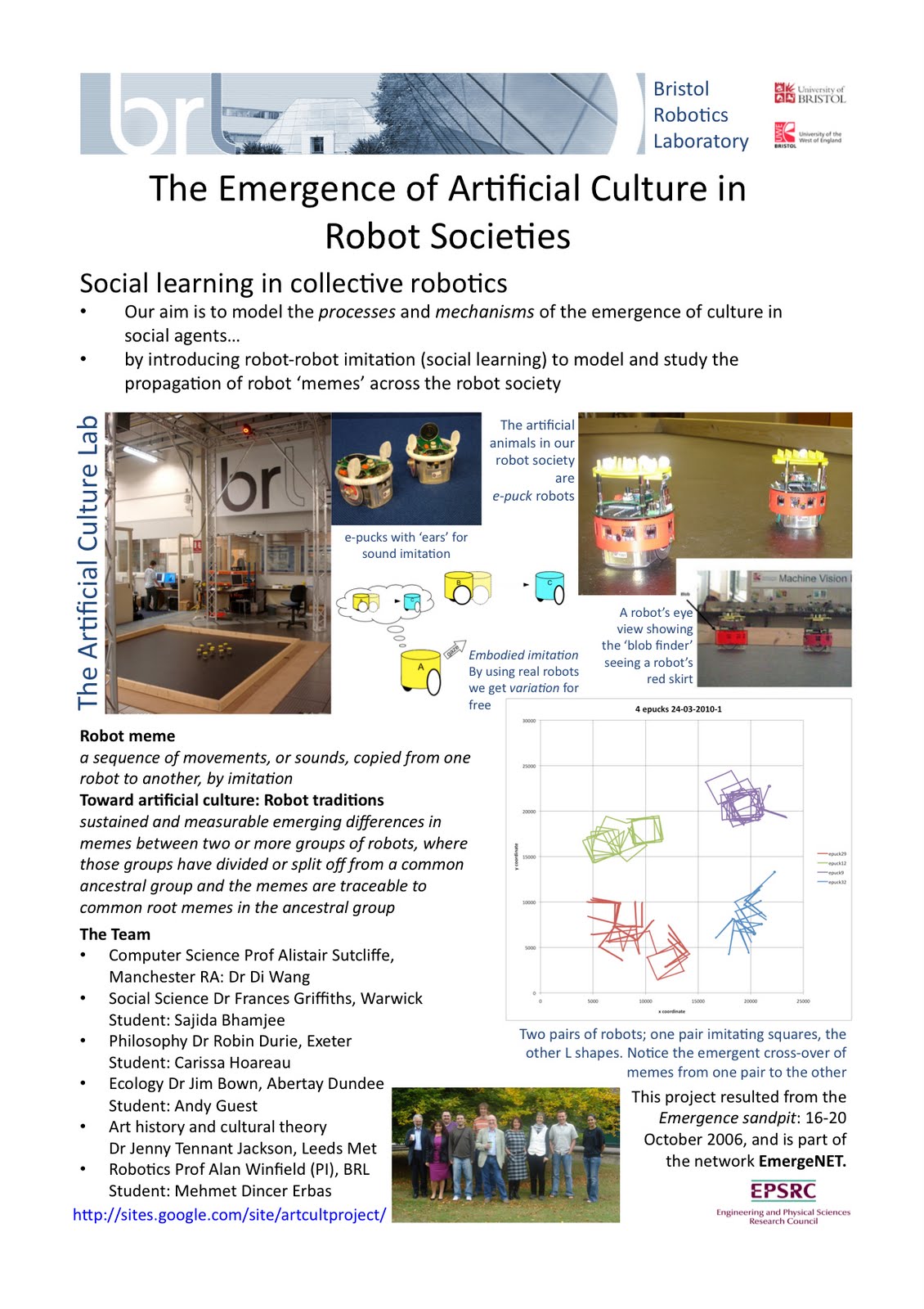
I took along some e-pucks and a portable arena, which proved very popular, together with this poster for the Artificial Culture project.

Wednesday, December 16, 2009

Mimetic Factors in Health and Well-being

On Monday I gave a talk at an amazingly interesting workshop in Warwick. Part of a project called Mimetic Factors in Health and Well-being, the workshop brought together a very diverse range of disciplines: sociology, medicine, systems science and robotics (and I may have missed a few).

Project lead, Steve Fuller, gave a great talk which reflected on both memetics (pre-Dawkins), and mimesis in advertising and PR. I found myself being introduced first to French sociologist Gabriel Tarde who, who - according to Steve Fuller - first articulated the pivotal role of imitation in society. Then to contemporary French social and cognitive scientist, and by the looks of it all round genius, Dan Sperber. I can see that I have to add Sperber to my reading list!

Saturday, September 26, 2009

Artificial Culture in Warwick

Yesterday we had a full artificial culture project team meeting in Warwick, following on from the EmergeNet meeting on Thursday (see my previous blog post). An excellent meeting, significant because we are now exactly half way through the project. Having spent much of the first two years of the project building the artificial culture lab, the project is now moving into the experimental phase. Having built our microscope we can now start looking through it.

The experimental phase of the project brings new challenges and we spent much of yesterday's meeting discussing and crystallising the detailed research questions that our experiments must address. Of course project team members each have questions and ideas that we want to address within our respective disciplines, but there must be overarching project-wide questions. Alistair led this discussion, wisely warning against the 'so what' problem ("Hey we've discovered x. Hmm interesting, but so what"). Taking a theory motivated approach, Alistair proposes four research questions addressing some key problems with the memetic theory of cultural evolution:
  1. What is the effect of fidelity of imitation on meme transmission?
  2. What is the effect of selection?
  3. What is the effect of size/granularity (of the meme)?
  4. What is the effect of complexity within the meme?

Thursday, June 25, 2009

Chimpanzee culture on Material World

There was a great piece on this afternoon's Material World - an interview with Andrew Whiten about cultural traditions in chimpanzees. Andrew Whiten makes the very interesting observation that while many animals appear to have 'traditions' (i.e. separate groups of the same bird species with different birdsong), chimpanzee have dozens of traditions. Does this mean that chimps have culture? I think so, yes.

Chimp culture appears, however, to have remained relatively static - Whiten observes that archeological investigation has shown traditions to have persisted for hundreds if not thousands of years. Longer, I would suspect, given that anatomically modern chimps have been around for over six million years. In other words, the big bang of human cultural evolution has never happened for chimps. What cognitive deficit in chimps might account for this..?

Friday, June 19, 2009

Artificial Culture web pages now up

Check out our new Artificial Culture project web pages:


These have been built using Google Sites. A remarkably straightforward way to create both the structure and content for a set of web pages, without HTML coding (actually I did have to tweak the code a couple of times). Integration with other Google applications means, for instance, that creating a slide show of images needs you only to upload the images to a Picasa album, then insert the slideshow gadget and point to the Picasa URL. Add another image to the album and it automatically appears in your web site slide show.

There is one limitation: while invited collaborators can sign-in and add comments - in blog fashion - to existing posts (as well as create and edit new pages), ordinary visitors to the web site cannot. Given that blog functionality is clearly built into the sites technology, it ought to be straightforward to provide an option to allow comments to be submitted, to selected pages, by non signed-in visitors. Or a blog gadget. Google..?

Thursday, April 23, 2009

Artificial Culture in Prague

I'm here at the brilliant European Union conference Science beyond Fiction, and yesterday gave my talk in the session on Collective Robotics: adaptivity, co-evolution, robot societies. I was pretty nervous because (a) this is my first talk on the Artificial Culture project to a international audience of senior researchers and (b) the project is still in its early development stages so we don't yet have any results. However, I'm pleased to say the talk went down well and I had some great questions - followed by conversations late into the evening.

Here is a movie of my presentation slides:


One of the questions was about robot imitation: are the robots learning to imitate, or have we pre-programmed them with imitation? My answer was that we have hand-coded imitation, in other words, our robots are endowed with an imitation instinct. You have to start somewhere, I argued, and this seems a good place to start and will initially allow us to study meme-evolution in our robot society in isolation from robot adaptation. While my questioners agreed, they also suggested that the evolution of imitation would also be really interesting, and encouraged us to - in effect - turn the evolutionary clock a little further back in our robot model of the emergence of culture.

Here are all of my blog posts on this project so far.