When I wrote about story-telling robots nearly 7 years ago I had no idea how we could actually build robots that can tell each other stories. Now I believe I do, and my paper setting out how has just been published in a new volume called Narrating Complexity. You can find a pdf online here.
The book emerged from a hugely interesting series of workshops, led by Richard Walsh and Susan Stepney, which brought together several humanities disciplines including narratology, with complexity scientists, systems biologists and a roboticist (me). It was at one of those workshops that I realised that simulation-based internal models - the focus of much of my recent work - could form the basis for story-telling.
To recap: a simulation-based internal model is a computer simulation of a robot and its environment, including other robots, inside itself. Like animals all robots have a set of next possible actions, but unlike animals (and especially humans) robots have only a small repertoire of actions. With an internal model a robot can predict what might happen (in its immediate future) for each of those next possible actions. I call this model a consequence engine because it gives the robot a powerful way of predicting the consequences of its actions, for both itself and other robots.
So, how can we use the consequence engine to make story-telling robots?
When the robot runs its consequence engine it is asking itself a 'what if' question; 'what if I turned left?' or, 'what if I just stand here?'. Some researchers have called a simulation-based internal model a 'functional imagination' and it's not a bad metaphor. Our robot 'imagines' what might happen in different circumstances. And when the robot has imagined something it has a kind of internal narrative: 'if I turn left I will likely crash into the wall'. In a way the robot is telling itself a story about something that might happen. In Dennett's conceptual Tower-of-Generate-and-Test the robot is a Popperian creature.
Now consider the possibility that the robot converts that internal narrative into speech, and literally speaks it out loud. With current speech synthesis technology that should be relatively easy to do. Here is a diagram showing this.
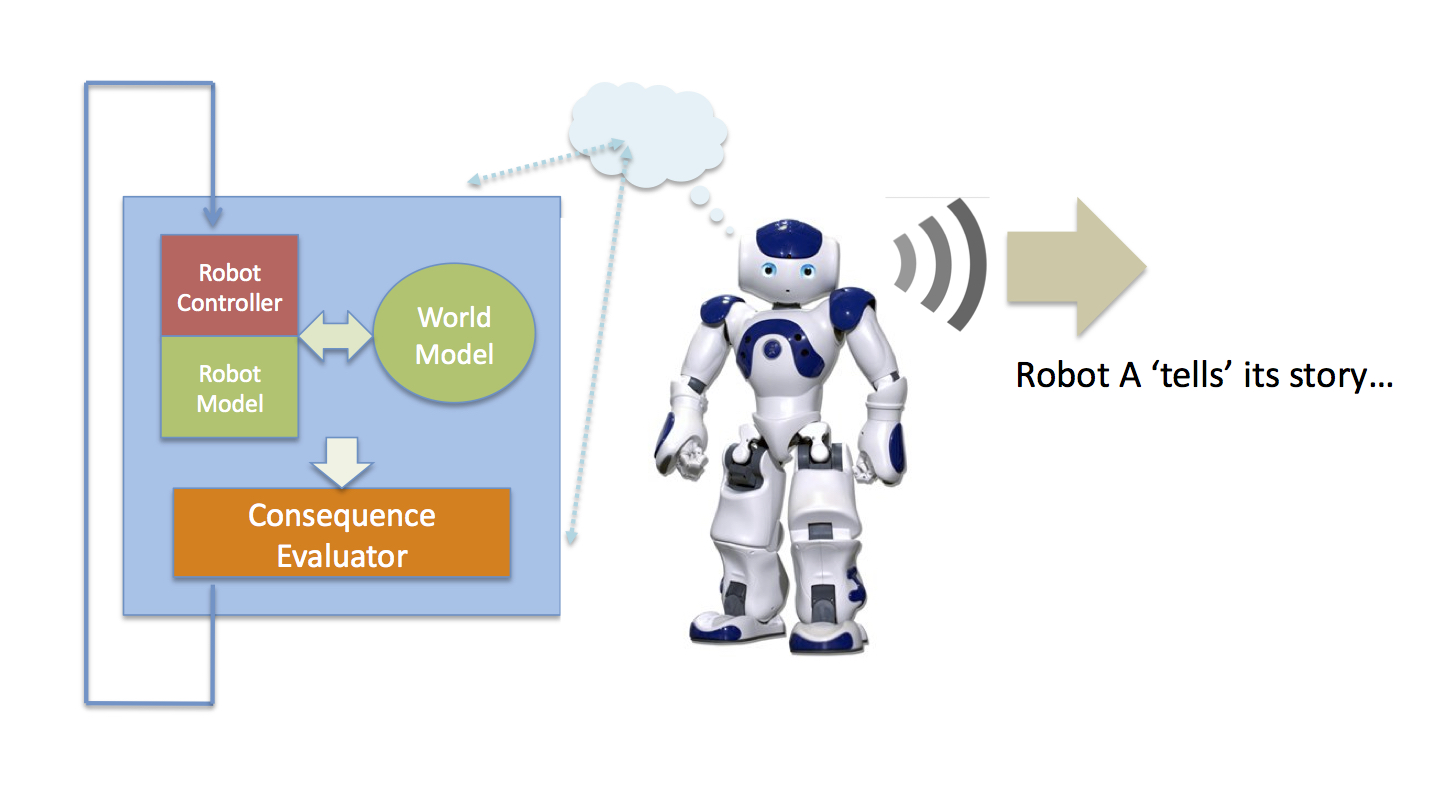
The blue box on the left is a simplified version of the consequence engine; it's the cognitive machinery that allows the robot to predict the consequences of a particular action. For an outline of how it works there's a description in the paper.
Another robot (B) is equipped with exactly the same cognitive machinery as robot A, and - as shown below robot B listens to robot A's 'story' (using speech recognition), interprets that story as an action and a consequence, which it 'runs' in its consequence engine. In effect robot B 'imagines' robot A's story. It 'imagines' turning left and crashing into the wall - even though it might not be standing near a wall to its left.
The new idea here is that the listener robot (B) converts the story it has heard into a 'what if' question, then 'runs' it in its own consequence engine. In a sense A has invited B to imagine itself in A's shoes. Although compared with the stories we humans tell each other, A's story is trivial, it does I suggest have all the key elements. And of course A and B are not limited to fictional stories: A could - just as easily - recount something that has actually happened to it, like 'I turned right to avoid crashing into the wall'.
You may be wondering 'ok but where is the meaning? Surely B cannot really understand A's simple stories..?' Here I am going to stick my neck out and suggest that the process of re-imagining is what understanding is. Of course you and I can imagine a vast range of things, including situations that no human has ever (or perhaps could ever) experience; Roy Batty's famous line "I've seen things you people wouldn't believe. Attack ships on fire off the shoulder of Orion..." comes to mind.
In contrast our robots have a profoundly limited imagination; their world (both real and imagined) contains only the objects and hazards of their immediate environment and they are capable only of imagining next possible actions and the immediate consequences of those actions. And that limited imagination does have the simple physics of collisions built in (providing the robot with a kind of common sense). But I contend that - within the constraints of that very limited imagination - our robots can properly be said to 'understand' each other.
But perhaps I'm getting ahead of myself, given that we haven't actually run the experiments yet.
Showing posts with label complex systems. Show all posts
Sunday, January 27, 2019
Friday, July 08, 2016
Relax, we're not living in a computer simulation
Since Elon Musk's recent admission that he's a simulationist, several people have asked me what I think of the proposition that we are living inside a simulation.
My view is very firmly that the Universe we are right now experiencing is real. Here are my reasons.
Firstly, Occam's razor; the principle of explanatory parsimony. The problem with the simulation argument is that it is a fantastically complicated explanation for the universe we experience. It's about as implausible as the idea that some omnipotent being created the universe. No. The simplest and most elegant explanation is that the universe we see and touch, both first hand and through our telescopes, LIGOs and Large Hadron Colliders, is the real universe and not an artifact of some massive computer simulation.
Second, is the problem of the Reality Gap. Anyone who uses simulation as a tool to develop robots is well aware that robots which appear to work perfectly well in a simulated virtual world often don't work very well at all when the same design is tested in the real robot. This problem is especially acute when we are artificially evolving those robots. The reason for these problems is that the model of the real world and the robot(s) in it inside our simulation is an approximation. The Reality Gap refers to the less-than-perfect fidelity of the simulation; a better (higher fidelity) simulator would reduce the reality gap.
Anyone who has actually coded a simulator is painfully aware of the cost, not just computational but coding costs, of improving the fidelity of the simulation - even a little bit - is very high indeed. My long experience of both coding and using computer simulations teaches me that there is a law of diminishing returns, i.e. that the cost of each additional 1% of simulator fidelity costs far more than 1%. I rather suspect that the computational and coding cost of a simulator with 100% fidelity is infinite. Rather as in HiFi audio, the amount of money you would need to spend to perfectly reproduce the sound of a Stradivarius ends up higher than the cost of hiring a real Strad and a world-class violinist to play it for you.
At this point the simulationists might argue that the simulation we are living in doesn't need to be perfect, just good enough. Good enough to do what exactly? To fool us that we're living in a simulation, or good enough to run on a finite computer (i.e. one that has finite computational power and runs at a finite speed). The problem with this argument is that every time we look deeper into the universe we see more: more galaxies, more sub-atomic particles, etc. In short we see more detail. The Voyager 1 spacecraft has left the Solar System without crashing, like Truman, into the edge of the simulation. There are no glitches like deja vu in The Matrix.
My third argument is about the computational effort, and therefore energy cost of simulation. I conjecture that to non-trivially simulate a complex system x (i.e. human), requires more energy than the real x consumes. An equation to express this inequality looks like this; how much greater depends on how high the fidelity of the simulation.
Let me explain. The average human burns around 2000 Calories a day, or about 9000 KJoules of energy. How much energy would a computer simulation of a human require, capable of doing all the same stuff (even in a virtual world) that you can in your day? Well that's impossible to estimate because we can't simulate complete human brains (let alone the rest of a human). But here's one illustration. Lee Sedol played AlphaGo a few months ago. In a single 2 hour match he burned about 170 Calories - the amount of energy you'd get from an egg sandwich. In the same 2 hours the AlphaGo machine consumed around 50,000 times more energy.
What can we simulate? The most complex organism that we have been able to simulate so far is the Nematode worm c-elegans. I previously estimated that the energy cost of simulating the nervous system of a c-elegans is (optimistically) about 9 J/hour, which is about 2000 times greater than the real nematode (0.004 J/hr).
I think there are lots of good reasons that simulating complex systems on a computer costs more energy than the same system consumes in the real world, so I'll ask you to take my word for it (I'll write about it another time). And what's more the relationship between energy cost and mass is logarithmic, following Kleiber's Law, and I strongly suspect the same law applies to scaling up computational effort as I wrote here. Thus, if the complexity of an organism o is C, then following Kleiber's Law the energy cost of simulating that organism, e will be
Furthermore, the exponent X (which in Kleiber's law is reckoned to be between 0.66 and 0.75 for animals and 1 for plants), will itself be a function of the fidelity of the simulation, hence X(F), where F is a measure of fidelity.
By using the number of synapses as a proxy for complexity and making some guesses about the values of X and F we could probably estimate the energy cost of simulating all humans on the planet (much harder would be estimating the energy cost of simulating every living thing on the planet). It would be a very big number indeed, but that's not really the point I'm making here.
The fundamental issue is this: if my conjecture that to simulate complex system x requires more energy than the real x consumes is correct, then to simulate the base level universe would require more energy than that universe contains - which is clearly impossible. Thus we - even in principle - could not simulate the whole of our own observable universe to a level of fidelity sufficient for our conscious experience. And, for the same reason, neither could our super advanced descendents create a simulation of a duplicate ancestor universe for us to (virtually) live in. Hence we are not living in such a simulation.
My view is very firmly that the Universe we are right now experiencing is real. Here are my reasons.
Firstly, Occam's razor; the principle of explanatory parsimony. The problem with the simulation argument is that it is a fantastically complicated explanation for the universe we experience. It's about as implausible as the idea that some omnipotent being created the universe. No. The simplest and most elegant explanation is that the universe we see and touch, both first hand and through our telescopes, LIGOs and Large Hadron Colliders, is the real universe and not an artifact of some massive computer simulation.
Second, is the problem of the Reality Gap. Anyone who uses simulation as a tool to develop robots is well aware that robots which appear to work perfectly well in a simulated virtual world often don't work very well at all when the same design is tested in the real robot. This problem is especially acute when we are artificially evolving those robots. The reason for these problems is that the model of the real world and the robot(s) in it inside our simulation is an approximation. The Reality Gap refers to the less-than-perfect fidelity of the simulation; a better (higher fidelity) simulator would reduce the reality gap.
Anyone who has actually coded a simulator is painfully aware of the cost, not just computational but coding costs, of improving the fidelity of the simulation - even a little bit - is very high indeed. My long experience of both coding and using computer simulations teaches me that there is a law of diminishing returns, i.e. that the cost of each additional 1% of simulator fidelity costs far more than 1%. I rather suspect that the computational and coding cost of a simulator with 100% fidelity is infinite. Rather as in HiFi audio, the amount of money you would need to spend to perfectly reproduce the sound of a Stradivarius ends up higher than the cost of hiring a real Strad and a world-class violinist to play it for you.
At this point the simulationists might argue that the simulation we are living in doesn't need to be perfect, just good enough. Good enough to do what exactly? To fool us that we're living in a simulation, or good enough to run on a finite computer (i.e. one that has finite computational power and runs at a finite speed). The problem with this argument is that every time we look deeper into the universe we see more: more galaxies, more sub-atomic particles, etc. In short we see more detail. The Voyager 1 spacecraft has left the Solar System without crashing, like Truman, into the edge of the simulation. There are no glitches like deja vu in The Matrix.
My third argument is about the computational effort, and therefore energy cost of simulation. I conjecture that to non-trivially simulate a complex system x (i.e. human), requires more energy than the real x consumes. An equation to express this inequality looks like this; how much greater depends on how high the fidelity of the simulation.
Let me explain. The average human burns around 2000 Calories a day, or about 9000 KJoules of energy. How much energy would a computer simulation of a human require, capable of doing all the same stuff (even in a virtual world) that you can in your day? Well that's impossible to estimate because we can't simulate complete human brains (let alone the rest of a human). But here's one illustration. Lee Sedol played AlphaGo a few months ago. In a single 2 hour match he burned about 170 Calories - the amount of energy you'd get from an egg sandwich. In the same 2 hours the AlphaGo machine consumed around 50,000 times more energy.
What can we simulate? The most complex organism that we have been able to simulate so far is the Nematode worm c-elegans. I previously estimated that the energy cost of simulating the nervous system of a c-elegans is (optimistically) about 9 J/hour, which is about 2000 times greater than the real nematode (0.004 J/hr).
I think there are lots of good reasons that simulating complex systems on a computer costs more energy than the same system consumes in the real world, so I'll ask you to take my word for it (I'll write about it another time). And what's more the relationship between energy cost and mass is logarithmic, following Kleiber's Law, and I strongly suspect the same law applies to scaling up computational effort as I wrote here. Thus, if the complexity of an organism o is C, then following Kleiber's Law the energy cost of simulating that organism, e will be
Furthermore, the exponent X (which in Kleiber's law is reckoned to be between 0.66 and 0.75 for animals and 1 for plants), will itself be a function of the fidelity of the simulation, hence X(F), where F is a measure of fidelity.
By using the number of synapses as a proxy for complexity and making some guesses about the values of X and F we could probably estimate the energy cost of simulating all humans on the planet (much harder would be estimating the energy cost of simulating every living thing on the planet). It would be a very big number indeed, but that's not really the point I'm making here.
The fundamental issue is this: if my conjecture that to simulate complex system x requires more energy than the real x consumes is correct, then to simulate the base level universe would require more energy than that universe contains - which is clearly impossible. Thus we - even in principle - could not simulate the whole of our own observable universe to a level of fidelity sufficient for our conscious experience. And, for the same reason, neither could our super advanced descendents create a simulation of a duplicate ancestor universe for us to (virtually) live in. Hence we are not living in such a simulation.
Monday, December 22, 2014
Robot Bodies and how to Evolve them
Evolutionary robotics has been around for about 20 years: it's about 15 years since Stefano Nolfi and Dario Floreano published their seminal book on the subject. Yet, surprisingly the number of real, physical robots whose bodies have been evolved can be counted on the fingers of one hand. The vast majority of ER research papers are concerned with the evolution of robot brains - the robot's control system. Or, when robot bodies are evolved often the robot is never physically realised. This seems to me very odd, given that robots are real physical artefacts whose body shape - morphology - is deeply linked to their role and function.
The question of how to evolve real robot bodies and why we don't appear to have made much progress in the last 15 years was the subject of my keynote at the IEEE International Conference on Evolvable Systems (ICES 2014) in Orlando, a week ago. Here are my slides:
The talk was in three parts.
In part one I outlined the basic approach to evolving robots using the genetic algorithm, referring to figure 18: The four-stage process of Evolutionary Robotics, from chapter 5 of my book:
I then reviewed the state-of-the-art in evolving real robot bodies, starting with the landmark Golem project of Hod Lipson and Jordan Pollack, referencing both Henrik Lund and Josh Bongard's work on evolving Lego robots, then concluding with the excellent RoboGen project of Josh Auerbach, Dario Floreano and colleagues at EPFL. Although conceptually RoboGen has not moved far from Golem, it makes the co-evolution of robot hardware and controllers accessible for the first time, through the use of 3D-printable body parts which are compatible with servo-motors, and a very nice open-source toolset which integrates all stages of the simulated evolutionary process.
RoboGen, Golem and, as far as I'm aware, all work on evolving real physical robot bodies to date has used the simulate-then-transfer-to-real approach, in which the whole evolutionary process - including fitness testing - takes place in simulation and only the final 'fittest' robot is physically constructed. Andrew Nelson and colleagues in their excellent review paper point out the important distinction between simulate-then-transfer-to-real, and embodied evolution in which the whole process takes place in the real world - in real-time and real-space.
In part two of the talk I outlined two approaches to embodied evolution. The first I call an engineering approach, in which the process is completely embodied but takes place in a kind of evolution factory; this approach needs a significant automated infrastructure: instead of an manufactory we need an evofactory. The second approach I characterise as an artificial life approach. Here there is no infrastructure. Instead 'smart matter' somehow mates then replicates offspring over multiple generations in a process much more analogous to biological evolution. This was one of the ambitious aims of the Symbrion project which, sadly, met with only limited success. Trying to make mechanical robots behave like evolving smart matter is really tough.
Part three concluded by outlining a number of significant challenges to evolving real robot bodies. First I reflect on the huge challenge of evolving complexity. To date we've only evolved very simple robots with very simple behaviours, or co-evolved simple brain/body combinations. I'm convinced that evolving robots of greater (and useful) complexity requires a new approach. We will, I think, need to understand how to co-evolve robots and their ecosystems*. Second I touch upon a related challenge: genotype-phenotype mapping. Here I refer to Pfeifer and Bongard's scalable complexity principle - the powerful idea that we shouldn't evolve robots directly, but instead the developmental process that will lead to the robot, i.e. artificial evo-devo. Finally I raise the often overlooked challenge of the energy cost of artificial evolution.
But the biggest challenge remains essentially what it was 20 years ago: to fully realise the artificial evolution of real robots.
Some of the work of this talk is set out in forthcoming paper: AFT Winfield and J Timmis, Evolvable Robot Hardware, in Evolvable Hardware, eds M Trefzer and A Tyrrell, Springer, in press.
*I touch upon this in the final para of my paper on the energy cost of evolution here.
The question of how to evolve real robot bodies and why we don't appear to have made much progress in the last 15 years was the subject of my keynote at the IEEE International Conference on Evolvable Systems (ICES 2014) in Orlando, a week ago. Here are my slides:
The talk was in three parts.
In part one I outlined the basic approach to evolving robots using the genetic algorithm, referring to figure 18: The four-stage process of Evolutionary Robotics, from chapter 5 of my book:
RoboGen, Golem and, as far as I'm aware, all work on evolving real physical robot bodies to date has used the simulate-then-transfer-to-real approach, in which the whole evolutionary process - including fitness testing - takes place in simulation and only the final 'fittest' robot is physically constructed. Andrew Nelson and colleagues in their excellent review paper point out the important distinction between simulate-then-transfer-to-real, and embodied evolution in which the whole process takes place in the real world - in real-time and real-space.
In part two of the talk I outlined two approaches to embodied evolution. The first I call an engineering approach, in which the process is completely embodied but takes place in a kind of evolution factory; this approach needs a significant automated infrastructure: instead of an manufactory we need an evofactory. The second approach I characterise as an artificial life approach. Here there is no infrastructure. Instead 'smart matter' somehow mates then replicates offspring over multiple generations in a process much more analogous to biological evolution. This was one of the ambitious aims of the Symbrion project which, sadly, met with only limited success. Trying to make mechanical robots behave like evolving smart matter is really tough.
Part three concluded by outlining a number of significant challenges to evolving real robot bodies. First I reflect on the huge challenge of evolving complexity. To date we've only evolved very simple robots with very simple behaviours, or co-evolved simple brain/body combinations. I'm convinced that evolving robots of greater (and useful) complexity requires a new approach. We will, I think, need to understand how to co-evolve robots and their ecosystems*. Second I touch upon a related challenge: genotype-phenotype mapping. Here I refer to Pfeifer and Bongard's scalable complexity principle - the powerful idea that we shouldn't evolve robots directly, but instead the developmental process that will lead to the robot, i.e. artificial evo-devo. Finally I raise the often overlooked challenge of the energy cost of artificial evolution.
But the biggest challenge remains essentially what it was 20 years ago: to fully realise the artificial evolution of real robots.
Some of the work of this talk is set out in forthcoming paper: AFT Winfield and J Timmis, Evolvable Robot Hardware, in Evolvable Hardware, eds M Trefzer and A Tyrrell, Springer, in press.
*I touch upon this in the final para of my paper on the energy cost of evolution here.
Saturday, July 19, 2014
Estimating the energy cost of evolution
Want to create human-equivalent AI? Well, broadly speaking, there are 3 approaches open to you: design it, reverse-engineer it or evolve it. The third of these - artificial evolution - is attractive because it sidesteps the troublesome problem of having to understand how human intelligence works. It's a black box approach: create the initial conditions then let the blind watchmaker of artificial evolution do the heavy lifting. This approach has some traction. For instance David Chalmers, in his philosophical analysis of the technological singularity, writes "if we produce an AI by artificial evolution, it is likely that soon after we will be able to improve the evolutionary algorithm and extend the evolutionary process, leading to AI+". And since we can already produce simple AI by artificial evolution, then all that's needed is to 'improve the evolutionary algorithm'. Hmm. If only it were that straightforward.
About six months ago I asked myself (and anyone else who would listen): ok, but even if we had the right algorithm, what would be the energy cost of artificially evolving human-equivalent AI? My hunch was that the energy cost would be colossal; so great perhaps as to rule out the evolutionary approach altogether. That thinking, and some research, resulted in me submitting a paper to ALIFE 14. Here is the abstract:
And here's a very short (30 second) video introduction on YouTube:
About six months ago I asked myself (and anyone else who would listen): ok, but even if we had the right algorithm, what would be the energy cost of artificially evolving human-equivalent AI? My hunch was that the energy cost would be colossal; so great perhaps as to rule out the evolutionary approach altogether. That thinking, and some research, resulted in me submitting a paper to ALIFE 14. Here is the abstract:
This short discussion paper sets out to explore the question: what is the energy cost of evolving complex artificial life? The paper takes an unconventional approach by first estimating the energy cost of natural evolution and, in particular, the species Homo Sapiens Sapiens. The paper argues that such an estimate has value because it forces us to think about the energy costs of co-evolution, and hence the energy costs of evolving complexity. Furthermore, an analysis of the real energy costs of evolving virtual creatures in a virtual environment, leads the paper to suggest an artificial life equivalent of Kleiber's law - relating neural and synaptic complexity (instead of mass) to computational energy cost (instead of real energy consumption). An underlying motivation for this paper is to counter the view that artificial evolution will facilitate the technological singularity, by arguing that the energy costs are likely to be prohibitively high. The paper concludes by arguing that the huge energy cost is not the only problem. In addition we will require a new approach to artificial evolution in which we construct complex scaffolds of co-evolving artificial creatures and ecosystems.The full proceedings of ALIFE 14 have now been published online, and my paper Estimating the Energy Cost of (Artificial) Evolution can be downloaded here.
And here's a very short (30 second) video introduction on YouTube:
My conclusion? Well I reckon that the computational energy cost of simulating and fitness testing something with an artificial neural and synaptic complexity equivalent to humans could be around 10^14 KJ, or 0.1 EJ. But evolution requires many generations and many individuals per generation, and - as I argue in the paper - many co-evolving artificial species. Also taking account of the fact that many evolutionary runs will fail (to produce smart AI), the whole process would almost certainly need to be re-run from scratch many times over. If multiplying those population sizes, generations, species and re-runs gives us (very optimistically) a factor of 1,000,000 - then the total energy cost would be 100,000 EJ. In 2010 total human energy use was about 539 EJ. So, artificially evolving human-equivalent AI would need the whole human energy generation output for about 200 years.
The full paper reference:
Winfield AFT, Estimating the Energy Cost of (Artificial) Evolution, pp 872-875 in Proceedings of the Fourteenth International Conference on the Synthesis and Simulation of Living Systems, Eds. H Sayama, J Rieffel, S Risi, R Doursat and H Lipson, MIT Press, 2014.
Related blog posts:
Tuesday, July 24, 2012
When robots start telling each other stories...
About 6 years ago the late amazing Richard Gregory said to me, with a twinkle in his eye, "when your robots start telling each other stories, then you'll really be onto something". It was a remark with much deeper significance than I realised at the time.
Richard planted a seed that's been growing since. What I didn't fully appreciate then, but do now, is the profound importance of narrative. More than we perhaps imagine. Narrative is, I suspect, a fundamental property of both human societies and individual human beings. It may even be a universal property of all advanced societies of sentient social beings. Let me try and justify this outlandish claim. First, take human societies. We humans love to tell each other stories. Whether our stories are epic poems, love songs; stories told with sound (music), or movement (dance), or with stuff (sculpture or art). Stories about what we did today, or on our holidays, stories made with images (photos, or movies); true stories or fantasies, or stories about the Universe that strive to be true (science), or very formal abstract stories told with mathematics, stories are everywhere. Arguably human culture is mostly stories.
Since humans started remembering stories and passing them on orally, and more recently with writing, we have had history: the more-or-less-true grand stories of human civilisation. Even the many artefacts of our civilisation are kinds of stories. They are embodied stories, which narrate the process by which they were designed and made; the plans and drawings which we use to formally record those designs are literally stories which tell how to arrange and join materials in space to fashion the artefact. Project plans are narratives of a different kind: they tell the story of the future steps that must be taken to achieve a goal. Computer programs are stories too. Except that they contain multiple narratives (bifurcated with branches and reiterated with loops), whose paths are determined by input data, which are related over and over at blinding speed within the computer.
Richard planted a seed that's been growing since. What I didn't fully appreciate then, but do now, is the profound importance of narrative. More than we perhaps imagine. Narrative is, I suspect, a fundamental property of both human societies and individual human beings. It may even be a universal property of all advanced societies of sentient social beings. Let me try and justify this outlandish claim. First, take human societies. We humans love to tell each other stories. Whether our stories are epic poems, love songs; stories told with sound (music), or movement (dance), or with stuff (sculpture or art). Stories about what we did today, or on our holidays, stories made with images (photos, or movies); true stories or fantasies, or stories about the Universe that strive to be true (science), or very formal abstract stories told with mathematics, stories are everywhere. Arguably human culture is mostly stories.
Since humans started remembering stories and passing them on orally, and more recently with writing, we have had history: the more-or-less-true grand stories of human civilisation. Even the many artefacts of our civilisation are kinds of stories. They are embodied stories, which narrate the process by which they were designed and made; the plans and drawings which we use to formally record those designs are literally stories which tell how to arrange and join materials in space to fashion the artefact. Project plans are narratives of a different kind: they tell the story of the future steps that must be taken to achieve a goal. Computer programs are stories too. Except that they contain multiple narratives (bifurcated with branches and reiterated with loops), whose paths are determined by input data, which are related over and over at blinding speed within the computer.
Now consider individual humans. There is a persuasive view in psychology that each of us owes our identity, our sense of self, to our personal life stories. The physical stuff that makes us, the cells of our body, are regenerated and replaced continuously, so that there's very little of you that existed 5 years ago. (I just realised the fillings in my teeth are probably the oldest part of me!) Yet you are still you. You feel like the same you 10, 20 or in my case 50 years ago - since I first became self-aware. I think that it's the lived and remembered personal narrative of our lives that provides us with the feeling, the illusion if you like, of a persistent self. This is I think why degenerative brain diseases are so terrifying. They appear to eat away that personal narrative so devastatingly that the person is ultimately lost, even while their physical body continues living.
So I was tremendously excited to be invited to a cross-disciplinary workshop on Narrative and Complex Systems at the York Centre for Complex Systems Analysis a couple of weeks ago, co-organised by York Professors of English Richard Walsh, and Computer Science Susan Stepney. For the first time I found myself in a forum in which I could share and debate ideas on narrative.
In preparing for the workshop I realised that perhaps the idea of robots telling each other stories isn't as far fetched as it first appears. Think about a simple robot, like the e-puck. What does the story of its life consist of? Well, it is the complete history of all of the movements, including turns, etc, punctuated by interactions with its environment. Because the robot and its set of behaviours is simple, then those interactions are pretty simple too. It occurred to me that it is perfectly possible for a robot to remember everything that has ever happened to it. Now place a number of these robots together, in a simple 'society' of robots, and provide them with the mechanism to exchange 'life stories' (or more likely, fragments of life stories). This mechanism is something we already developed in the Artificial Culture project - it is social learning by imitation. These robots would be telling each other stories.
But, I hear you ask, would these stories have any meaning? Well, to start with I think we must abandon the notion that they would necessarily mean anything to us humans. After all, these are robots telling each other stories. Ok, so would the stories mean anything to the robots themselves, especially robots with limited 'cognition'? Now we are in the interesting territory of semiotics, or - to be more accurate - robosemiotics. What, for instance, would one robot's story signify to another? That signification would I think be the meaning. But I think to go any further we would need to do the robot experiment I have outlined here.
And what would be the point of my proposed robot experiment? It is, I suggest, this:
So I was tremendously excited to be invited to a cross-disciplinary workshop on Narrative and Complex Systems at the York Centre for Complex Systems Analysis a couple of weeks ago, co-organised by York Professors of English Richard Walsh, and Computer Science Susan Stepney. For the first time I found myself in a forum in which I could share and debate ideas on narrative.
In preparing for the workshop I realised that perhaps the idea of robots telling each other stories isn't as far fetched as it first appears. Think about a simple robot, like the e-puck. What does the story of its life consist of? Well, it is the complete history of all of the movements, including turns, etc, punctuated by interactions with its environment. Because the robot and its set of behaviours is simple, then those interactions are pretty simple too. It occurred to me that it is perfectly possible for a robot to remember everything that has ever happened to it. Now place a number of these robots together, in a simple 'society' of robots, and provide them with the mechanism to exchange 'life stories' (or more likely, fragments of life stories). This mechanism is something we already developed in the Artificial Culture project - it is social learning by imitation. These robots would be telling each other stories.
But, I hear you ask, would these stories have any meaning? Well, to start with I think we must abandon the notion that they would necessarily mean anything to us humans. After all, these are robots telling each other stories. Ok, so would the stories mean anything to the robots themselves, especially robots with limited 'cognition'? Now we are in the interesting territory of semiotics, or - to be more accurate - robosemiotics. What, for instance, would one robot's story signify to another? That signification would I think be the meaning. But I think to go any further we would need to do the robot experiment I have outlined here.
And what would be the point of my proposed robot experiment? It is, I suggest, this:
to explore, with an abstract but embodied model, the relationship between the narrative self and shared narrative, i.e. culture.
By doing this experiment would we be, as Richard Gregory suggested, really onto something?
Subscribe to:
Posts (Atom)


