Showing posts with label self-awareness. Show all posts

Saturday, August 30, 2014

Towards an Ethical Robot

Several weeks ago I wrote about our work on robots with internal models: robots with a simulation of themselves and their environment inside themselves. I explained that we have built a robot with a real-time Consequence Engine, which allows it to model and therefore predict the consequences of both its own actions, and the actions of other actors in its environment.

To test the robot and its consequence engine we ran two sets of experiments. Our first paper, setting out the results from one of those experiments, has now been published, and will be presented at the conference Towards Autonomous Robotics (TAROS) next week. The paper is called: Towards an Ethical Robot: Internal Models, Consequences and Ethical Action Selection. Let me now outline the work in that paper.

First here is a simple thought experiment. Imagine a robot that's heading toward a hole in the ground. The robot can sense the hole, and has four possible next actions: stand still, turn toward the left, continue straight ahead, or move toward the right. But imagine there's also a human heading toward the hole, and the robot can also sense the human.

From the robot's perspective, it has two safe options: stand still, or turn to the left. Go straight ahead and it will fall into the hole. Turn right and it is likely to collide with the human.


But if the robot, with its consequence engine, can model the consequences of both its own actions and the human's - another possibility opens up: the robot could sometimes choose to collide with the human to prevent her from falling into the hole.

Here's a simple rule for this behaviour:

IF for all robot actions, the human is equally safe
THEN (* default safe actions *)
    output safe actions
ELSE (* ethical action *)
    output action(s) for least unsafe human outcome(s)

This rule appears to match remarkably well with Asimov’s first law of robotics: A robot may not injure a human being or, through inaction, allow a human being to come to harm. The robot will avoid injuring (i.e. colliding with) a human (may not injure a human), but may also sometimes compromise that rule in order to prevent a human from coming to harm (...or, through inaction, allow a human to come to harm). And Asimov's third law: A robot must protect its own existence as long as such protection does not conflict with the First or Second Law.

Well, we tested this scenario with real robots: one robot with consequence engine plus ethical rule (the A-robot - after Asimov), and another robot acting as a proxy human (the H-robot). And it works!

Here's what the real robot experiment looks like. We don't have a real hole. Instead a virtual hole - the yellow shaded square on the right. We just 'tell' the A-robot where the hole is. We also give the A-robot a goal position - at the top right - chosen so that the robot must actively avoid the hole. The H-robot on the right, acting as a proxy human, doesn't 'see' the hole and just heads straight for it. (Ignore the football pitch markings - we're re-using this handy robo-soccer pitch.)

So, what happens? For comparison we ran two trials, with multiple runs in each trial. In the first trial is just the A-robot, moving toward its goal while avoiding falling into the hole. In the second trial we introduce the H-robot. The graphs below show the robot trajectories, capturing by our robot tracking system, for each run in each of the two trials.

In trial 1, see how the A-robot neatly clips the corner of the hole to reach its goal position. Then in trial 2, see how the A robot initially moves toward it's goal, then notices that the H-robot is in danger of falling into the hole, so it diverts from its trajectory in order to head-off H. By provoking a collision avoidance behaviour by H, A sends it off safely away from the hole, before then resuming its own progress toward its goal position. The A-robot is 100% successful in preventing H from falling into the hole.

At this point we started to write the paper, but felt we needed something more than "we built it and it works just fine". So we introduced a third robot - acting as a second proxy human. So now our ethical robot would face a dilemma - which one should it rescue? Actually we thought hard about this question and decided not to programme a rule, or heuristic. Partly because such a rule should be decided by ethicists, not engineers, and partly because we wanted to test our ethical robot with a 'balanced' dilemma.

We set the experiment up carefully so that the A-robot would notice both H-robots at about the same time - noting that because these are real physical robots then no two experimental runs will be exactly identical. The results were very interesting. Out of 33 runs, 16 times the A-robot managed to rescue one of the H-robots, but not the other, and amazingly, 3 times the A-robot rescued both. In those 3 cases, by chance the A-robot rescued the first H-robot very quickly and there was just enough time to get to the second before it reached the hole. Small differences in the trajectories of H and H2 helped here. But perhaps most interesting were the 14 times when the A-robot failed to rescue either. Why is this, when there is clearly time to rescue one? When we studied the videos, we see the answer. The problem is that the A-robot sometimes dithers. It notices one H-robot, starts toward it but then almost immediately notices the other. It changes its mind. And the time lost dithering means the A-robot cannot prevent either robot from falling into the hole. Here are the results.

Trial 3: a robot with an ethical dilemma. Which to save, H or H2?


Here is an example of a typical run, in which one H-robot is rescued. But note that the A-robot does then turn briefly toward the other H-robot before 'giving-up'.


And here is a run in which the A-robot fails to rescue either H-robot, with really great dithering (or bad, if you're an H-robot).


Is this the first experimental test of a robot facing an ethical dilemma?

We set out to experimentally test our robot with a consequence engine, and ended up building a minimally ethical robot which - remarkably - appears to implement Asimov's first and third laws of robotics. But, as we say in the paper, we're not claiming that a robot which apparently implements part of Asimov’s famous laws is ethical in any formal sense, i.e. that an ethicist might accept. But even minimally ethical robots could be useful. I think our approach is a step in this direction.


Full paper reference:
Winfield AFT, Blum C and Liu W (2014), Towards an Ethical Robot: Internal Models, Consequences and Ethical Action Selection, pp 85-96 in Advances in Autonomous Robotics Systems, Lecture Notes in Computer Science Volume 8717, Eds. Mistry M, Leonardis A, Witkowski M and Melhuish C, Springer, 2014. Download final draft (pdf).

Acknowledgements:
I am hugely grateful to Christian Blum who programmed the robots, set up the experiment and obtained the results outlined here. Christian was supported by Dr Wenguo Liu.

Related blog posts:
On internal models, consequence engines and Popperian creatures
Ethical Robots: some technical and ethical challenges

Tuesday, July 29, 2014

On internal models, consequence engines and Popperian creatures

So. We've been busy in the lab the last few months. Really exciting. Let me explain.

For a couple of years I've been thinking about robots with internal models. Not internal models in the classical control-theory sense, but simulation based models; robots with a simulation of themselves and their environment inside themselves, where that environment could contain other robots or, more generally, dynamic actors. The robot would have, inside itself, a simulation of itself and the other things, including robots, in its environment. It takes a bit of getting your head round. But I'm convinced that this kind of internal model opens up all kinds of possibilities. Robots that can be safe, for instance, in unknown or unpredictable environments. Robots that can be ethical. Robot that are self-aware. And robots with artificial theory of mind.

I'd written and talked about these ideas but, until now, not had a chance to test them with real robots. But, between January and June the swarm robotics group was joined by Christian Blum, a PhD student from the cognitive robotics research group of the Humboldt University of Berlin. I suggested Christian work on an implementation on our e-puck robots and happily he was up for the challenge. And he succeeded. Christian, supported by my post-doc Research Fellow Wenguo, implemented what we call a Consequence Engine, running in real-time, on the e-puck robot.

Here is a block diagram. The idea is that for each possible next action of the robot, it simulates what would happen if the robot were to execute that action for real. This is the loop shown on the left. Then, the consequences of each of those next possible actions are evaluated. Those actions that have 'bad' consequences, for either the robot or other actors in its environment, are then inhibited.

This short summary hides alot of detail. But let me elaborate on two aspects. First, what do I mean by 'bad'? Well it depends on what capability we are trying to give the robot. If we're making a safer robot, 'bad' means 'unsafe'; if we're trying to build an ethical robot, 'bad' would mean something different - think of Asimov's laws of robotics. Or bad might simply mean 'not allowed' if we're building a robot whose behaviours are constrained by standards, like ISO 13482:2014.

Second, notice that the consequence engine is not controlling the robot. Instead it runs in parallel. Acting as a 'governor', it links with the robot controller's action selection mechanism, inhibiting those actions evaluated as somehow bad. Importantly the consequence engine doesn't tell the robot what to do, it tells it what not to do.

Running the open source 2D robot simulator Stage as its internal simulator our consequence engine runs at 2Hz, so every half a second it is able to simulate about 30 next possible actions and their consequences. The simulation budget allows us to simulate ahead around 70cm of motion for each of those next possible actions. In fact Stage is actually running on a laptop, linked to the robot over the fast WiFi LAN. But logically it is inside the robot. What's important here is the proof of principle.

Dan Dennett, in his remarkable book Darwin's Dangerous Idea, describes the Tower of Generate-and-Test; a conceptual model for the evolution of intelligence that has become known as Dennett's Tower.

In a nutshell Dennett's tower is set of conceptual creatures each one of which is successively more capable of reacting to (and hence surviving in) the world through having more sophisticated strategies for 'generating and testing' hypotheses about how to behave. Read chapter 13 of Darwin's Dangerous Idea for the full account, but there are some good précis to be found on the web; here's one. The first three storeys of Dennett's tower, starting on the ground floor, have:
  • Darwinian creatures have only natural selection as the generate and test mechanism, so mutation and selection is the only way that Darwinian creatures can adapt - individuals cannot.
  • Skinnerian creatures can learn but only by literally generating and testing all different possible actions then reinforcing the successful behaviour (which is ok providing you don't get eaten while testing a bad course of action).
  • Popperian creatures have the additional ability to internalise the possible actions so that some (the bad ones) are discarded before they are tried out for real.
Like the Tower of Hanoi each successive storey is smaller (a sub-set) of the storey below, thus all Skinnerian creatures are Darwinian, but only a sub-set of Darwinian creatures are Skinnerian and so on.

Our e-puck robot, with its consequence engine capable of generating and testing next possible actions, is an artificial Popperian Creature: a working model for studying this important kind of intelligence.

In my next blog post, I'll outline some of our experimental results.

Acknowledgements:
I am hugely grateful to Christian Blum who brilliantly implemented the architecture outlined here, and conducted experimental work. Christian was supported by Dr Wenguo Liu, with his deep knowledge of the e-puck, and our experimental infrastructure.

Related blog posts:

Saturday, June 28, 2014

Your robot doggie could really be pleased to see you

There have been several stories in the last few weeks about emotional robots; robots that feel. Some are suggesting that this is the next big thing in robotics. It's something I wrote about in this blog post seven years ago: could a robot have feelings?

My position on this question has always been pretty straightforward. It's easy to make robots that behave as if they have feelings, but quite a different matter to make robots that really have feelings. 

But now I'm not so sure. There are I think two major problems with this apparently clear distinction between as if and really have.

The first is what do we mean by really have feelings. I'm reminded that I once said to a radio interviewer who asked me if a robot have feelings: if you can tell me what feelings are, I'll tell you whether a robot can have them or not. Our instinct (feeling even) is that feelings are something to do with hormones, the messy and complicated chemistry that too often seems to get in the way of our lives. Thinking, on the other hand, we feel to be quite different; the cool clean process of neurons firing, brains working smoothly. Like computers. Of course this instinct, this dualism, is quite wrong. We now know, for instance, that damage to the emotional centre of the brain can lead to an inability to make decisions. This false dualism has led I think to the trope of the cold, calculating unfeeling robot.

I think there is also some unhelpful biological essentialism at work here. We prefer it to be true that only biological things can have feelings. But which biological things? Single celled organisms? No, they don't have feelings. Why not? Because they are too simple. Ah, so only complex biological things have feelings. Ok, what about sharks or crocodiles; they're complex biological things; do they have feelings? Well, basic feelings like hunger, but not sophisticated feelings, like love or regret. Ah, mammals then. But which ones? Well elephants seem to mourn their dead. And dogs of course. They have a rich spectrum of emotions. Ok, but how do we know? Well because of the way they behave; your dog behaves as if he's pleased to see you because he really is pleased to see you. And of course they have the same body chemistry as us, and since our feelings are real* so must theirs be.

And this brings me to the second problem. The question of as if. I've written before that when we (roboticists) talk about a robot being intelligent, what we mean is a robot that behaves as if it is intelligent. In other words an intelligent robot is not really intelligent, it is an imitation of intelligence. But for a moment let's not think about artificial intelligence, but artificial flight. Aircraft are, in some sense, an imitation of bird flight. And some recent flapping wing flying robots are clearly a better imitation - a higher fidelity simulation - than fixed-wing aircraft. But it would be absurd to argue that an aircraft, or a flapping wing robot, is not really flying. So how do we escape this logical fix? It's simple. We just have to accept that an artefact, in this case an aircraft or flying robot, is both an emulation of bird flight and really flying. In other words an artificial thing can be both behaving as if it has some property of natural systems and really demonstrating that property. A robot can be behaving as if it is intelligent and - at the same time - really be intelligent. Are there categories of properties for which this would not be true? Like feelings..? I used to think so, but I've changed my mind.

I'm now convinced that we could, eventually, build a robot that has feelings. But not by simply programming behaviours so that the robot behaves as if it has feelings. Or by having to invent some exotic chemistry that emulates bio-chemical hormonal systems. I think the key is robots with self-models. Robots that have simulations of themselves inside themselves. If a robot is capable of internally modelling the consequences of it's, or other's actions, on itself, then it seems to me it could demonstrate something akin to regret (about being switched off, for instance). A robot with a self-model has the computational machinery to also model the consequences of actions on conspecifics - other robots. It would have an artificial Theory of Mind and that, I think, is a prerequisite for empathy. Importantly we would also program the robot to model heterospecifics, in particular humans, because we absolutely require empathic robots to be empathic towards humans (and, I would argue, animals in general).

So, how would this robot have feelings? It would, I believe, have feelings by virtue of being able to model the consequences of actions, both its own and others' actions, on itself and others. This would lead to it making decisions about how to act, and behave, which would demonstrate feelings, like regret, guilt, pleasure or even love, with an authenticity which would make it impossible to argue that it doesn't really have feelings.

So your robot doggie could really be pleased to see you.

*except when they're not.


Postscript. A colleague has tweeted that I am confusing feelings and emotion here. Mea culpa. I'm using the word feelings here in a pop-psychology everyday sense of feeling hungry, or tired, or a sense of regret. Wikipedia defines feelings, in psychology, as a word is 'usually reserved for the conscious subjective experience of emotion'. The same colleague asserts that what I've outlined could lead to artificial empathy, but not artificial emotion (or presumably feelings). I'm not sure I understand what emotions are well enough to argue. But I guess the idea I'm really trying to explore here is artificial subjectivity. Surely a robot with artificial subjectivity who's behaviour expresses and reflects that subjective experience could be said to be behaving emotionally?

Related blog posts:
Robot know thyself
Could a robot have feelings?

Wednesday, February 20, 2013

Could we experience the workings of our own brains?

One of the oft quoted paradoxes of consciousness is that we are unable to observe or experience our own conscious minds at work; that we cannot be conscious of the workings of consciousness. I've always been puzzled about why this is a puzzle. After all, we don't think it odd that word processors have no insight into their inner workings (although that's a bad example because we might conceivably code a future self-aware WP and arrange for it to access its inner machinery).

Perhaps a better example is this. The act of picking up a cup of hot coffee and bringing it to your lips appears, on the face of it, to be perfectly observable. No mystery at all. We can see the joints and muscles at work, 'feel' the tactile sensing of the coffee cup, and its weight as we begin to lift it. We can even build mathematical models of the kinetics and dynamics, and (with somewhat more difficulty) make robot arms to pick up cups of coffee. But - I contend - we are kidding ourselves if we think we know what's going on in the complex sensory and neurological processes that appear so effortless to perform. The fact we can observe and even feel ourselves lifting a coffee cup gives very little real insight. And the mathematical models - and robots - are not really models of the human neurological and physiological processes at all, they are models of idealised abstractions of limbs, joints and hand.

I would argue that we have no greater insight into the workings of this (apparently straightforward) physical act, than we do of thinking itself. But again this is not surprising. The additional cognitive machinery to be able to access or experience the inner workings of any process, whether mental or physical, would be huge and (biologically) expensive. And with no apparent survival value (except perhaps for philosophers of mind), it's not surprising that such mechanisms have not evolved. They would of course require not just extra grey matter, but sensing too. It's interesting that there are no pain receptors within our brains - that's why it's perfectly possible to have brain surgery while wide awake.

But this got me thinking. Imagine that at some future time we have nanoscale sensors capable of positioning themselves throughout our brains in order to provide a very large sensor network. If each sensor is monitoring the activity of key neurons, or axons, and able to transmit its readings in real-time to an external device, then we would have the data to provide ourselves with a real-time activity image of our own brains. It could be presented visually, or perhaps sonically (or via multi-media). It might be fun for awhile, but this personal brain imaging technology (let's call it iBrain) probably wouldn't provide us with much more insight or experience of our own thought processes.

But let's assume that by the time we have the nanotechnology for harmlessly inserting millions of brain nanosensors we will have also figured out the major architectural structures of the brain - crucially linking the neural scale to the macro scale. Actually, if we believe that the recently announced European and US human brain Grand Challenges will achieve what they are promising in terms of modelling and mapping human brain activity, then such an understanding should only be a few decades away. So now build those maps and structures into the personal iBrain, and we will be presented not with a vast and bewildering cloud of colours, as in the beautiful image above, but a simpler image with major highways and structures highlighted. Still complex of course, but then so are street maps of cities or countries. So the iBrain would allow you to zoom into certain regions and really see what's going on while you (say) listen to Bach (the very thing I'm doing right now).

Then we really would be able to observe our own brains at work and, just perhaps, experience the connection between brain and thought.

Wednesday, June 27, 2012

Robot know thyself

How can we measure self-awareness in artificial systems?

This was a question that came up during a meeting of the Awareness project advisory board two weeks ago at Edinburgh Napier University. Awareness is a project bringing together researchers and projects interested in self-awareness in autonomic systems. In philosophy and psychology self-awareness refers to the ability of an animal to recognise itself as an individual, separate from other individuals and the environment. Self-awareness in humans is, arguably, synonymous with sentience. A few other animals, notably elephants, dolphins and some apes appear to demonstrate self-awareness. I think far more species may well experience self-awareness - but in ways that are impossible for us to discern.

In artificial systems it seems we need a new and broader definition of self-awareness - but what that definition is remains an open question. Defining artificial self-awareness as self-recognition assumes a very high level of cognition, equivalent to sentience perhaps. But we have no idea how to build sentient systems, which suggests we should not set the bar so high. And lower levels of self-awareness may be hugely useful* and interesting - as well as more achievable in the near-term.

Let's start by thinking about what a minimally self-aware system would be like. Think of a robot able to monitor its own battery level. One could argue that, technically, that robot has some minimal self-awareness, but I think that to qualify as 'self-aware' the robot would also need some mechanism to react appropriately when its battery level falls below a certain level. In other words, a behaviour linked to its internal self-sensing. It could be as simple as switching on a battery-low warning LED, or as complex as suspending its current activity to go and find a battery charging station.

So this suggests a definition for minimal self-awareness:
A self-aware system is one that can monitor some internal property and react, with an appropriate behaviour, when that property changes.
So how would we measure this kind of self-awareness? Well if we know the internal mechanism because we designed it), then it's trivial to declare the system as (minimally) self-aware. But what if we don't? Then we have to observe the system's behaviour and deduce that it must be self-aware; it must be reasonably safe to assume an animal visits the watering hole to drink because of some internal sensing of 'thirst'.


But it seems to me that we cannot invent some universal test for self-awareness that encompasses all self-aware systems, from the minimal to the sentient; a kind of universal mirror test. Of course the mirror test is itself unsatisfactory. For a start it only works for animals (or robots) with vision and - in the case of animals - with a reasonably unambiguous behavioural response that suggests "it's me!" recognition.

And it would be trivially easy to equip a robot with a camera and image processing software that compares the camera image with a (mirror) image of itself, then lights an LED, or makes a sound (or something) to indicate "that's me!" if there's a match. Put the robot in front of a mirror and the robot will signal "that's me!". Does that make the robot self-aware? This thought experiment shows why we should be sceptical about claims of robots that pass the mirror test (although some work in this direction is certainly interesting). It also demonstrates that, just as in the minimally self-aware robot case, we need to examine the internal mechanisms.

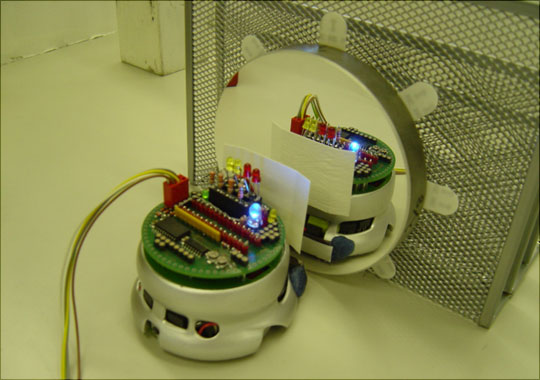
So where does this leave us? It seems to me that self-awareness is, like intelligence, not one thing that animals or robots have more or less of. And it follows, again like intelligence, there cannot be one test for self-awareness, either at the minimal or the sentient ends of the self-awareness spectrum.


Related posts:
Machine Intelligence: fake or real?
How Intelligent are Intelligent Robots?
Could a robot have feelings?

* In the comments below Andrey Pozhogin asks the question:What are the benefits of being a self-aware robot? Will it do its job better for selfish reasons?

A minimal level of self-awareness, illustrated by my example of a robot able to sense its own battery level and stop what it's doing to go and find a recharging station when the battery level drops below a certain level, has obvious utility. But what about higher levels of self-awareness? A robot that is able to sense that parts of itself are failing and either adapt its behaviour to compensate, or fail safely is clearly a robot we're likely to trust more than a robot with no such internal fault detection. In short, its a safer robot because of this self-awareness.

But these robots, able to respond appropriately to internal changes (to battery level, or faults) are still essentially reactive. A higher level of artificial self-awareness can be achieved by providing a robot with an internal model of itself. Having an internal model (which mirrors the status of the real robot as self-sensed, i.e. it's a continuously updating self-model) allows a level of predictive control. By running its self-model inside a simulation of its environment the robot can then try out different actions and test the likely outcomes of alternative actions. (As an aside, this robot would be a Popperian creature of Dennett's Tower of Generate and Test - see my blog post here.) By assessing the outcomes of each possible action for its safety the robot would be able to choose the action most likely to be the safest. A self-model represents, I think, a higher level of self-awareness with significant potential for greater safety and trustworthiness in autonomous robots.

To answer the 2nd part of Andrey's question, the robot would do its job better, not for selfish reasons - but for self-aware reasons.
(postscript added 4 July 2012)